
Your board and sponsors want proof that zero waste is more than a slogan. This Zero Waste Event Checklist starts with one target: at least 90% diversion, with 10% or less sent to landfill.
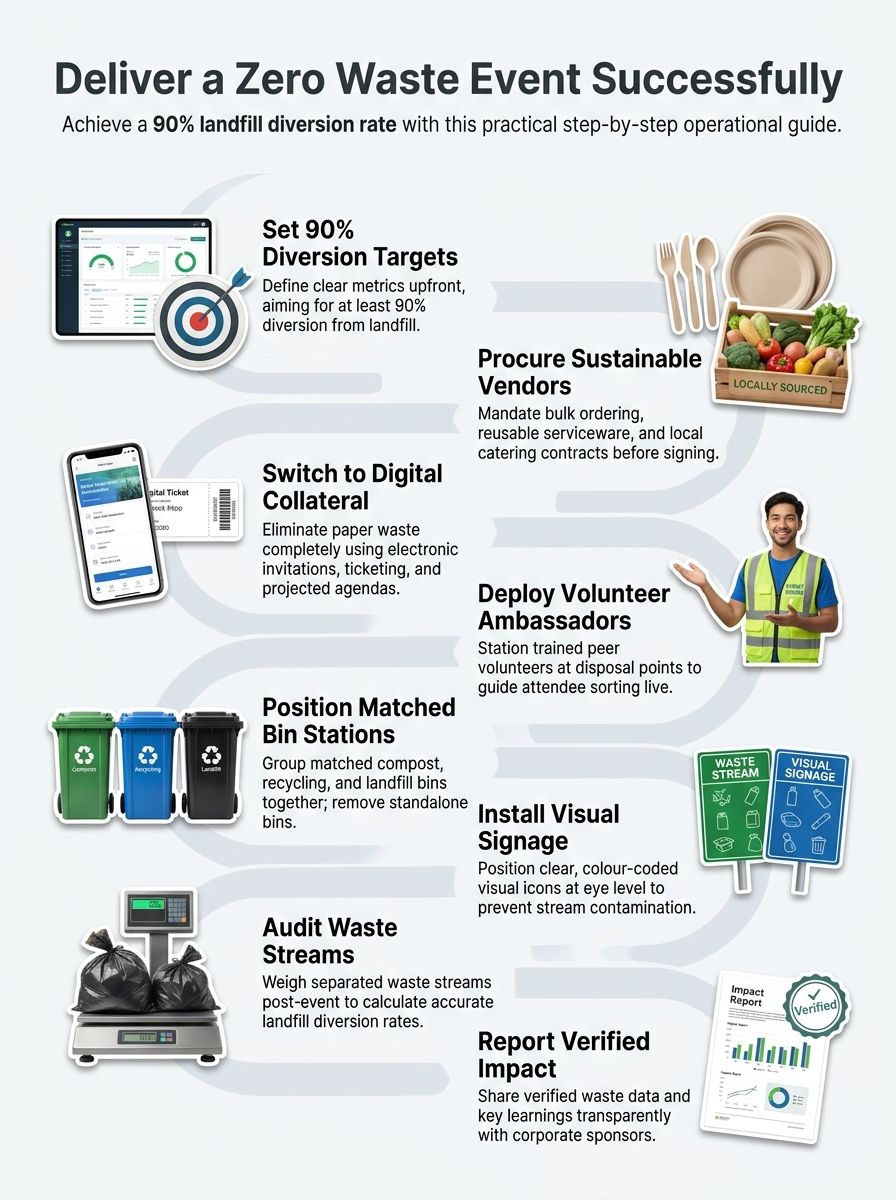
The steps run in this order. Choose reuse-first suppliers and put the rules in their contracts. Place matched compost, recycling and landfill bins with signs and trained helpers. Then weigh each stream, check the numbers and report the result. Each step has a time, from 12 weeks out to the sponsor report.
Key Takeaways
- Set a target of at least 90% diversion, and agree how you will weigh each waste stream before you book anything.
- Put zero waste into supplier briefs and contracts, because a written clause gives you something to enforce.
- Place matched compost, recycling and landfill bins side by side, with clear signs and a trained helper at busy stations.
- Weigh every stream, work out the diversion rate, and send sponsors a short, honest report with evidence attached.
- Festivals need extra plans for camping gear, production waste and glitter.
Before the Event: Set Targets, Brief Suppliers and Build Your Circular Materials Plan
Most of your waste is decided before the gates open. What you order, and how it arrives, sets what you will have to bin.
Use this timeline as a starting point for your project plan. The timings are suggestions, so adjust them to your event.
- 12 weeks out: Set your diversion target, pull baseline figures from past events, and write your supplier brief.
- 8 weeks out: Sign contracts with zero waste clauses. Get written confirmation from your waste collector that they accept every item suppliers plan to use. Agree how each stream will be weighed.
- 4 weeks out: Draw your bin layout, order signs, and start telling attendees and sponsors what to expect.
- 1 week out: Brief and train your helpers, walk the site, and check that every station has all three bins.
Set zero waste goals
Pick one number and write it down. Set a target of at least 90% diversion, with 10% or less sent to landfill.
If you have figures from past events, use them as your baseline. If you do not, say so, and treat this event as the one that sets it.
Decide your reporting boundary now. Say whether it covers build, show and get-out, and whether it includes public, trader, crew and production waste. Count each item once.
Be realistic. Paris 2024 reported that nearly 79% of waste from operations was recovered or avoided. That measure is not a like-for-like diversion rate, so use it as a sense of scale only. It was also a huge event with huge resources, so 90% is a real stretch.
Standards can give your plan a frame. They do not prove your waste result, so be clear about what each one covers.
- ISO 20121:2024: This is an event sustainability management standard. It applies to events of all types and sizes, and asks organisations to manage social, economic and environmental impacts responsibly. It also guides you to build this into planning and delivery. It does not set a 90% waste target.
- Net Zero Carbon Events pledge: This one is about greenhouse gas emissions, not waste. Signatories commit to reach net zero by 2050 at the latest, and to halve emissions by 2030.
- Julie’s Bicycle toolkit: This free toolkit is built around 10 steps. It gives practical step-by-step guidance for those who manage waste at greenfield festivals, plus checklists to monitor and review actions.
Track three numbers all the way through: compost, recycling and landfill, each in kilograms. Those three numbers are the heart of your final report.
Source sustainable vendors and suppliers
Reuse first, then recycle, then compost. Landfill is the last resort.
Your supplier brief should be short and specific. Cover these seven points.
- Reusable plates, cups, cutlery and serving gear, or compostable ones where reuse is not possible.
- Bulk ordering and bulk delivery, so there is less packaging to dispose of.
- Drinks from taps, bulk dispensers or refill points, not single-use bottles.
- Decorations, signs and give-aways that can be reused or that you can do without.
- Food choices that cut waste, such as local, seasonal, vegetarian and vegan menus, with dietary needs still met.
- Take-back of leftover packaging, pallets and crates by the supplier.
- Weights or counts of what each supplier brings and removes, supplied after the event.
Then check each supplier’s sustainability credentials. Ask what they already do, not just what they promise.
Supplier contract wording you can copy
A request in an email is easy to drop. A clause gives you a written obligation and a remedy, though it cannot promise compliance. Adapt these lines with your legal team.
- Packaging: The supplier will not bring single-use plastic items to site, and will supply goods in reusable or returnable packaging wherever possible.
- Serviceware: All food and drink will be served in reusable items, or in compostable items on the approved-materials list attached to this contract. No compostable item may be ordered until the organiser’s waste collector or processor has confirmed in writing that it accepts that item.
- Take-back: The supplier will remove its own packaging, pallets and unused stock at the end of the event.
- Data: The supplier will report the weight of waste it produced, by stream, with collector tickets, within an agreed number of days of the event.
- Remedy: If the supplier breaches these terms, the organiser may withhold an agreed part of the fee, or require the item to be replaced on site.
Whether you use a penalty or a bonus is your call. We’d suggest starting with the data clause, since you cannot report what you cannot measure.
How Do You Tell Attendees and Sponsors About Your Zero Waste Plan?
Tell them early, tell them often, and tell them what you want them to do. Waste habits are easiest to change before people arrive, when they are still packing and planning.
Educate attendees on zero waste practices
Start four weeks out with email, your event page and social channels. Say what you are aiming for, what to bring and what not to bring.
Ask people to bring a refillable bottle, and make sure you have somewhere to fill it. At Paris 2024, a survey of 1,000 spectators found that 80% took the chance to fill their own bottles at free water fountains.
On the day, helpers at bin stations do the teaching in real time. They show people which item goes where and correct mistakes kindly. Brief every team member, not just the bin crew, so a question at the bar or the stage gets the same answer.
Use digital invitations and materials
Go digital wherever you can. Send invitations, tickets and agendas by email, and show schedules on screens instead of handing out print.
Use QR codes or a short link for maps, menus and sponsor information. Run feedback surveys online too, so the same channel supports your post-event report.
Keep a little paper for access needs, since not everyone can use a phone. The aim is less waste, not fewer people included.
Brief your sponsors before the day
Sponsors want to know what you will measure and when they will see it. Send them a one-page plan with your target, your boundary, your method and your reporting date.
This matters for brand reasons. The 2025 Edelman Trust Barometer special report found that trust has become a new axis of competition, with trust equal to price and quality in brand purchase decisions for the first time.
We’d argue a clear, checked waste report is one of the simplest ways to earn that trust. A vague claim that you recycled lots does the opposite.
On the Day: Bins, Signage and Staffing That Work
On the day, your job is to make the right choice the easy one. Put the bins where waste is made, and put a person next to them.
Set up recycling, composting, and waste stations
- Place matched sets of compost, recycling and landfill bins side by side at every station. Never put out a single bin on its own.
- Remove or cover standard rubbish bins, so people have to use your stations.
- Put stations near food service, seating, bars and exits, where waste peaks. Walk the site against your layout drawing and follow the foot traffic.
- Staff each station with a trained helper at every peak period, and keep doing so until contamination checks show people have learned the system.
- Match the bins to what your caterers actually serve. A cup that your compost route does not accept becomes contamination, so agree the approved list first.
- Test the layout the day before, and fix gaps, clashes and poorly lit spots.
- Plan how to empty bins without mixing the streams. Keep each stream’s bags and trolleys separate, and check each station at set times during peaks.
Here is an example station schedule. Say you run a one-day festival with a food court, a bar and a campsite. Adapt the rows to your site.
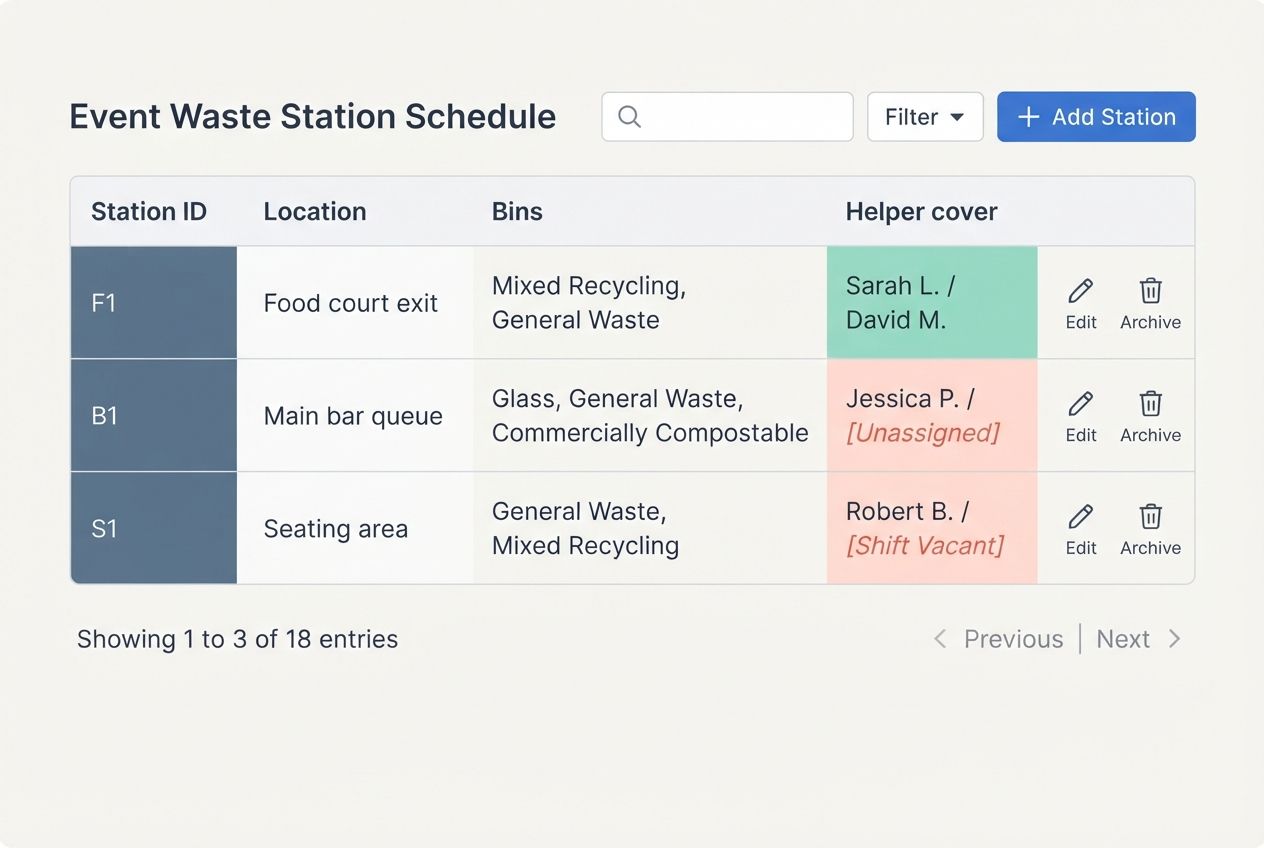
| Station ID | Location | Bins | Helper cover | Collection route |
|---|---|---|---|---|
| F1 | Food court exit | Compost, recycling, landfill, plus a separate reusable-cup return | Every peak period | Service road, checked at set times |
| B1 | Main bar queue and exit | Compost, recycling, landfill, plus a reusable-cup return | Every peak period | Service road |
| S1 | Seating area | Compost, recycling, landfill | Roving helper | Path edge |
| C1 | Campsite route | Compost, recycling, landfill, plus a donation point | Morning of departure | Campsite track |
| X1 | Backstage and crew area | Compost, recycling, landfill | Briefed crew lead | Compound |
Size the bins for your peak, not your average. Reusable and refill systems cut waste before it reaches a bin. Paris 2024 reported a 52% reduction in single-use plastic, by weight, in the supply of drinks, and a 70% reduction in the number of single-use plastic bottles used to serve beverages, both compared with London 2012.
Provide clear and visible signage
Put signs at eye level, right above or beside the bins. Use photos or icons of real items from your event, with a few plain words, so people can match what is in their hand.
Use the same colours and wording at every station. Check the signs in the dark, in bright sun and from a distance.
If your caterers change their items, change your signs. Walk the site on day one, note where contamination appears, and fix it before day two.
After the Event: Run a Waste Audit and Report the Results
A waste audit sounds technical, but at its simplest it means weighing each stream and doing one sum. Do it while the numbers are fresh, then report quickly.
| Audit step | What to do | What you end up with |
|---|---|---|
| 1. Weigh each stream | Weigh compost, recycling and landfill separately across your whole boundary. Use weight tickets from your waste contractor, or weigh bags on site with a hanging scale. | Three figures in kilograms, each backed by a ticket or log entry. |
| 2. Confirm what was accepted | Ask the contractor for destination confirmation and any rejected loads. Move rejected material into the landfill figure. | Accepted recycling and compost weights you can defend. |
| 3. Calculate the diversion rate | Add accepted recycling and accepted compost. Divide by total waste (recycling plus compost plus landfill), then multiply by 100. | One percentage to compare with your 90% target. |
| 4. Check contamination | Sort a sample of bags from each stream by hand. Note what is in the wrong bin and which stall it came from. | A list of the main problem items and the stations where they appeared. |
| 5. Review suppliers and feedback | Compare supplier data with your contract clauses. Send a short online survey asking about signs and bin access. | A clear view of who kept to the brief, and what attendees found confusing. |
| 6. Record and archive | Store the figures, dates, method, tickets and bin layout in one shared file. | A baseline for next year, and evidence you can show an auditor or sponsor. |
For hand-sorting, use trained staff, gloves and other protective equipment, and a clear sharps protocol. Never push a hand into a bag.
Analyse waste data and performance
Keep a simple weigh log. Use these columns: date, station, stream, gross weight, tare weight, net weight, destination and evidence reference, such as a ticket number.
Report reusable serviceware separately, as waste prevention. Do not add its circulating weight to your diversion figure. If any waste goes to energy recovery, disclose that route separately too.
Here is a worked example. Say the confirmed accepted weights for every 100 kg of waste are 50 kg recycling, 40 kg compost and 10 kg landfill. Your diversion rate is (50 + 40) ÷ 100 à 100, which is 90%.
Now say landfill is 21 kg out of every 100 kg. Your rate is 79%, a clear miss against a 90% target, so you look at which stream caused it.
If compost bins were full of plastic, your signs or your caterers’ items need fixing. If landfill is mostly packaging, go back to your supplier brief.
Be honest about what your number means
Zero waste, waste diversion and carbon are three different things. Diversion tells you where waste went, not how much was made, so cutting waste at source is still the better win.
Waste is also only one part of an event’s carbon footprint. A diversion figure says nothing about your emissions.
So make a precise claim. For example, write that you diverted a stated percentage of your measured waste from landfill. Avoid broad labels such as carbon neutral or green. Precise claims are the ones sponsors can trust.
Share results with stakeholders
Send a one-page report within four weeks of the event, while the details are fresh. That is a suggested deadline, so set your own and tell sponsors. Include these five items.
- Your target and the result, side by side.
- The weights for compost, recycling and landfill, and the boundary they cover.
- How you measured them, who collected the waste, and the contractor tickets attached.
- What missed the target, and why.
- Three changes you will make next time.
Include your gaps. A report that shows a miss and a fix is more believable than one that shows perfect numbers. If you are working to ISO 20121:2024, keep the report and the audit records together as evidence.
Your Zero Waste Event Checklist at a Glance
Copy this table into your project plan. It covers corporate events and festivals, with festival tasks built in. All timings are suggestions.
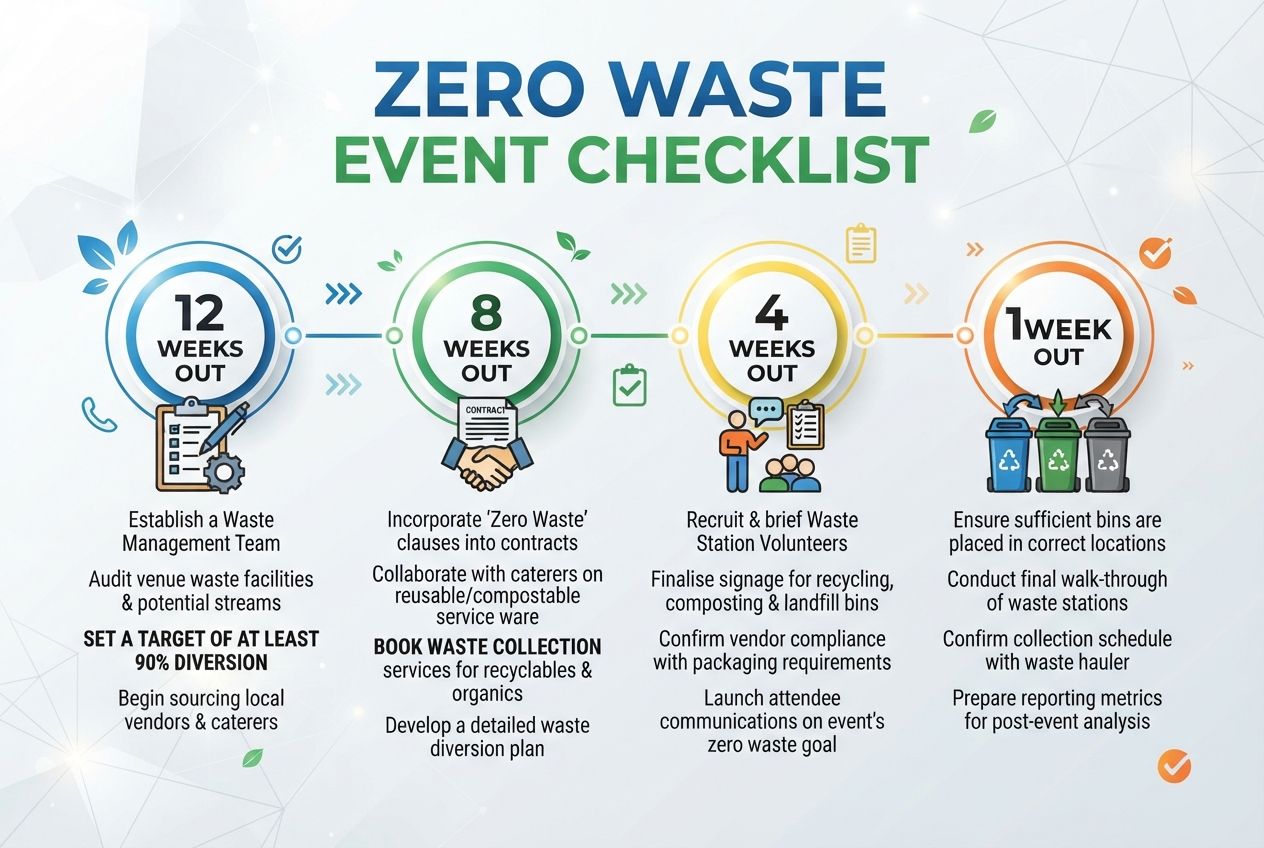
| When | Action | Owner | Deliverable or evidence | Done |
|---|---|---|---|---|
| 12 weeks out | Set a target of at least 90% diversion. Define the reporting boundary, gather baseline figures and write the supplier brief. | Event lead | Signed-off target, boundary note and supplier brief | â |
| 8 weeks out | Put zero waste clauses and data reporting into contracts. Get written collector acceptance of all serviceware. Book waste collection. Festivals: agree production take-back and name a donation recipient. | Procurement and production manager | Signed contracts, approved-materials list, collector confirmation | â |
| 4 weeks out | Draw the bin layout and station schedule, order signs, and tell attendees and sponsors your plan. Festivals: share camping and glitter rules before arrival. | Site manager and communications lead | Layout drawing, sign proofs, sent emails, sponsor one-pager | â |
| 1 week out | Train helpers, test the stations, and check that every set has three bins. | Waste lead | Training sign-in sheet, site walk notes | â |
| Build and show | Staff stations at peaks, keep streams separate, check contamination and fix signage fast. Log every weight. | Waste lead and helpers | Completed weigh log | â |
| Get-out | Treat get-out as part of the event. Festivals: staff campsite recovery during departure, and weigh production and camping waste. | Production manager and waste lead | Get-out weigh log, donation record | â |
| 2 weeks after | Receive contractor and supplier data. Chase anything missing. | Procurement | Tickets and destination confirmations | â |
| 4 weeks after | Calculate the diversion rate and send the one-page report to sponsors and your board. | Event lead | Report with tickets attached, archived file | â |
If you want a second view, another 10-step checklist covers large and small events, including office parties and conferences.
Festival Add-Ons: Camping, Production Waste and Glitter
Festivals have waste problems that offices do not. Julie’s Bicycle and Vision: 2025 research named the main ones: single-use plastics such as bottles, bags and food trays, bulky production waste, wood and set waste, tents and camping equipment, and microplastic pollution from glitter and toiletries.
Sustainable materials and waste management is a priority for festival organisers, and a key challenge, according to Vision: 2025’s annual Event Industry Green Survey. The toolkit’s 10 steps are a good place to start.
- Camping: Tell campers early to take their tents and gear home. Name a real donation recipient for usable items, and staff the donation point during pack-down.
- Production and set waste: Put reuse and take-back into contractor agreements. Ask stage and build crews to plan for wood, panels and set pieces to be reused or returned, not skipped.
- Single-use plastics: Ban plastic bottles, bags and food trays in trader agreements, and offer refill points.
- Glitter and toiletries: Do not allow traders to sell loose plastic glitter, and ask campers to leave single-use toiletries at home.
- Measurement: Weigh crew, trader, production and camping waste as well as public waste, or your diversion rate will look better than it is.
Use the toolkit’s checklists to review your progress during build, show and get-out. Get-out is when the biggest skips fill up, so keep weighing until the site is clear.
Copy the checklist above into your plan, fill in the owners, and you have a working zero waste event checklist from target to sponsor report.
FAQs
1. What is a zero waste event checklist?
It is a step-by-step plan that helps you cut rubbish at every stage, from supplier choices to clear-up. A 2024 study by WRAP UK found that events using structured waste checklists divert an average of 85 per cent more material from landfill than those without one.
2. Does a zero waste event really mean sending nothing to landfill?
Not quite, and that is a common myth. Most organisers aim to divert at least 90 per cent of waste through reuse, recycling and composting, which aligns with the Zero Waste International Alliance standard.
3. Where should planners start?
Start with your suppliers, because research shows that 60 to 70 per cent of event waste typically comes from what they bring on site. Ask caterers, printers and stage crews to use reusable, compostable or returnable items, and put it in the contract.
4. How can I track whether the plan is working?
Run a waste audit after the event, weighing each bin stream: recycling, compost and general waste. According to the UK Events Industry Board, accurate waste audits should record weights within 5 per cent accuracy to be meaningful. Then compare the figures with your targets, spot the weak points, and fix them before the next event.
Innovative Waste Management Ideas: Transforming The Future Of Waste Disposal
Everyone wants to live in a clean world, but rubbish makes it hard. We know that smart ways to handle waste can change the future. Innovative waste management leverages advanced technology and circular economy models to minimize landfill usage and reclaim valuable resources. Key trends include AI-powered sorting facilities, smart IoT bins for optimizing collection […]

Old Electronics Recycling: How To Responsibly Dispose Of Unwanted Devices
You probably have at least 25 unused electronic devices sitting in drawers or cupboards right now. Most households do because most neglect their old electronics recycling. And most people have no clear plan for what to do with their old electronic devices when they go wrong.. Here’s the key issue: those devices aren’t just clutter. […]

Waste To Energy: A Blind Spot In Global Methane Policy? The Waste Sector’s WtE Debate
You can see why waste-to-energy (WtE), often just known as “incineration”, has become a blind spot in methane policy. The toughest part of municipal solid waste management is rarely the clean paper, glass, or metals that people picture when they think about recycling; it is the messy residual waste left after sorting. Maybe most of […]
Revolutionizing Waste Recovery: Latest Separation And Sorting Innovations
Waste recovery is changing fast, thanks to new separation and sorting technology. This tech helps us sort trash better, so we can recycle more things. For example, Stadler has built a big plant in Spain for VAERSA that makes recycling easier and smarter. Keson is finding new ways to deal with old tyres, helping both […]