If you are weighing Cloth vs Disposable Nappies, the awkward truth is that both options work well, they just create very different problems for you to manage.One choice usually saves money and cuts environmental impact. The other saves time, travels better, and usually keeps skin drier for longer stretches.
HealthyChildren notes that most US parents use nearly 3,000 nappies in the first year alone, so this is not a small buying decision. Modern cloth diapers are nothing like the old folded squares, and modern disposable diapers rely on a superabsorbent hydrogel core that changed how dry babies stay between changes.
In this guide, I will break down the real pros and cons, the likely cost, what matters for diaper rash and diaper dermatitis, and where hybrid systems can make daily diapering easier.Read on.
Key Diaper Debate Takeaways
- Cloth diapers usually cost more at the start, but they often save money over time because you reuse them across months, and sometimes across a second child.
- Disposable diapers are still the easiest option for nights, travel, childcare hand-offs, and families who want the quickest change with the least laundry.
- For skin, the answer is not absolute. Cloth puts fewer manufactured layers against the skin, while disposables are usually more absorbent, which is why frequent changes matter more than brand loyalty.
- If you want a middle ground, hybrid systems such as gDiapers combine a washable outer with a replaceable insert, which can reduce waste without locking you into full-time laundry.
What is the history of diapers?
The word diaper originally referred to a type of patterned cloth, which tells you how long cloth diapers have been part of family life. For generations, parents used linen, towelling, pins, and waterproof covers, then washed and reused the same pieces day after day.The big shift began in the late 1940s, when inventor Marion Donovan created a waterproof cover called the Boater. A few years later, Procter & Gamble engineer Victor Mills pushed the idea further, and Pampers reached US shops in 1961.
That was the moment disposable nappies moved from novelty to mainstream.That history still matters today. If you prefer simplicity, disposable design has been refined for decades around speed, leak control, and one-handed changes.
If you care more about reuse, modern cloth has evolved just as sharply, with shaped fits, snaps, inserts, and washable covers that feel far removed from the old square nappy and safety pin setup.

What are the main types of diapers?
There are still two main camps, cloth and disposable, but each now comes in several versions. For everyday skin-care advice, the American Academy of Pediatrics remains a sensible place to start, especially if your baby is prone to diaper rash or repeated leaks.| Type | What it is | Best for | Watch out for |
|---|---|---|---|
| Cloth all-in-one | A reusable nappy with absorbency sewn in | Parents who want the simplest cloth routine | Longer drying time |
| Cloth pocket, prefold, or fitted | A reusable shell plus inserts or folded absorbent layers | Lower long-run cost and flexible absorbency | More assembly and laundry |
| Disposable | A single-use nappy with a waterproof back sheet and gel core | Travel, nights, quick changes | Higher ongoing spend and more bin waste |
| Hybrid | A washable outer with a replaceable insert | Families who want a middle ground | You still buy inserts and must manage fit carefully |
What are cloth diapers?
Cloth nappies are reusable and washable. The main styles are all-in-ones, pocket nappies, fitted nappies with covers, and prefolds or flats folded into shape. Fabrics usually include cotton, hemp, bamboo blends, microfibre, or a mix of several layers.The practical detail most new parents miss is stash size. In cloth-diaper communities, 24 to 30 nappies is a common sweet spot for one baby if you want to wash every other day instead of every night.That makes a huge difference to whether cloth feels manageable in the first year or like a chore that never ends.Hybrid brands such as gDiapers add another option. They use a washable outer with a replaceable insert, which appeals to families who want less daily rubbish but are not ready for full-time laundry.
What are disposable diapers?
Disposable nappies use a waterproof outer layer, a moisture-wicking inner layer, and an absorbent core that usually includes superabsorbent gel. That layered design is the reason they stay thin while still holding far more liquid than older paper-heavy versions.Most mainstream packs now include leak guards, stretch tabs, and a wetness indicator, which is one reason disposables remain the default choice for many US families.Researchers from Stanford University and the National Institutes of Health have also looked at how materials in modern nappies interact with skin and chemical exposure in real use.A 2023 US survey of 31 disposable hygiene products found measurable volatile organic compounds in products sold on the market. That does not mean every disposable nappy is unsafe, but it is a good reason to choose fragrance-free options if your baby has reactive skin or repeated diaper rashes.
Advantages and disadvantages of cloth diapers
Cloth nappies make the most sense for families who want to cut repeat spending and reduce landfill waste. They ask more from you at home, though, because the savings come from routine: sorting, washing, drying, and keeping enough clean nappies ready.What are the benefits of cloth diapers?
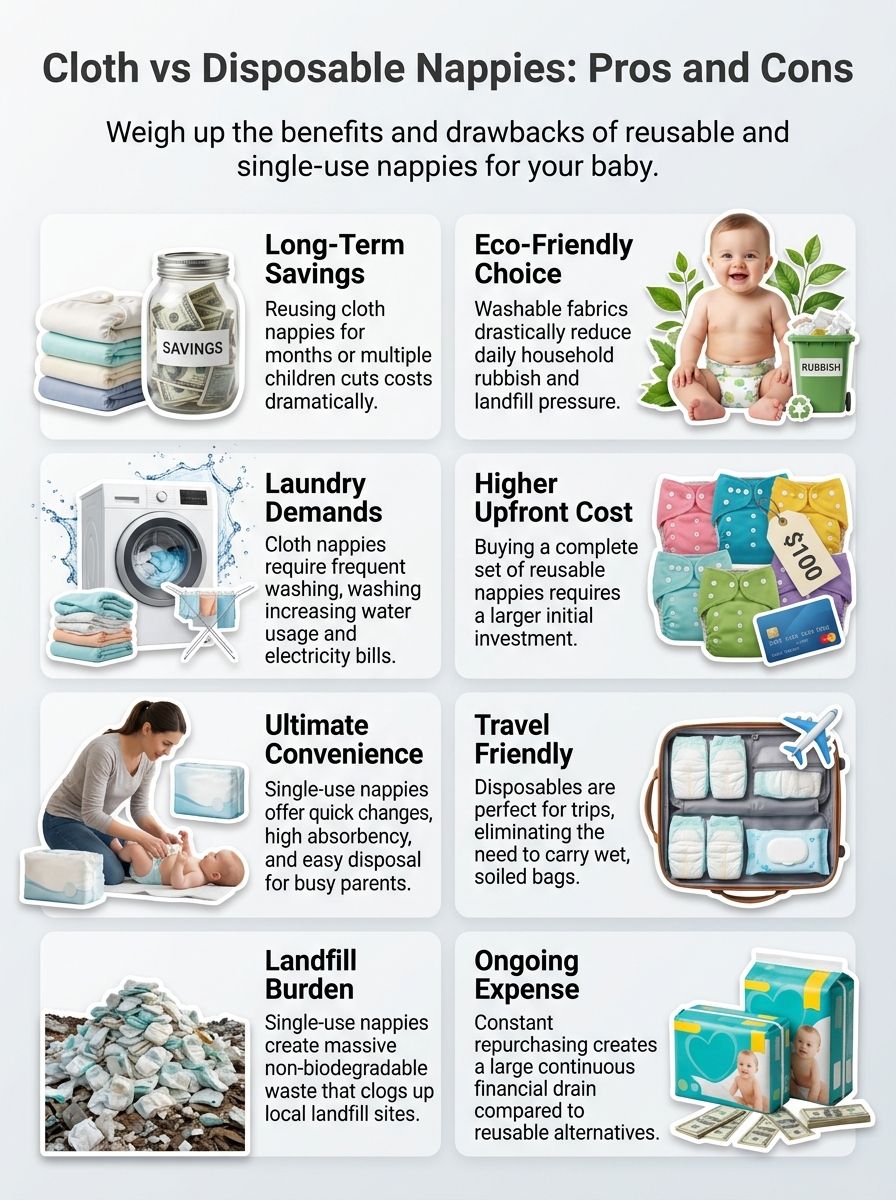
Many parents are drawn to cloth for one simple reason: the financial logic improves the longer you use them.- They can save money over time. The National Diaper Bank Network says infants may need up to 12 diapers a day, with disposables often costing $80 to $100 or more per month. A reusable stash shifts more of that spend to the beginning.
- They reduce daily rubbish. EPA figures show disposable diapers generated 4.1 million tons of municipal solid waste in its latest product-specific dataset, so even part-time cloth can noticeably shrink what leaves your home each week.
- You control the materials. If your baby reacts badly to fragrance, dyes, or certain liners, cloth lets you choose simple cotton or hemp next to the skin.
- They can support earlier wetness awareness. Cloth is less absorbent than most disposables, so some toddlers notice wetness sooner. That does not guarantee faster potty training, but it can make readiness cues easier to spot.
- They are easier to reuse. A cloth stash can serve a second child, be passed on, or be bought second-hand, which is where the long-run savings become much stronger.
- Modern designs are much easier than older nappies. Snaps, hook-and-loop tabs, shaped inserts, and wet bags remove much of the old frustration people still imagine.
Why do cloth diapers cost less long-term?
Cloth diapers usually cost less long-term because you stop buying the product after every single change. You pay once for the core setup, then mostly cover laundry, extra inserts, and the occasional replacement.The useful budgeting question is not whether cloth is cheaper in week one, because it rarely is. The better question is how long you will be diapering, whether you plan to reuse the stash, and whether you are open to second-hand buying.| Cost area | Cloth | Disposable |
|---|---|---|
| Upfront spend | Usually a few hundred dollars for a workable starter stash | Low, because you buy a pack at a time |
| Monthly spend | Laundry, detergent, occasional liners or boosters | Often $80 to $100 or more in the early months |
| Second child value | Often very strong if the stash is still in good shape | No reuse value |
How are cloth diapers eco-friendly?
US EPA product-specific waste data shows that disposable diapers generated 4.1 million tons of waste in 2018, with roughly 3.3 million tons landfilled and no significant recycling or composting identified. That is the clearest reason many families switch at least part-time.Cloth is not impact-free, because washing uses water and electricity.The smart move is to run full loads, wash on a consistent schedule, and line-dry when practical. Those choices matter because the washing stage is where most of cloth’s footprint sits.If sustainability is your main goal, part-time cloth is still worth considering. Using reusable nappies at home and keeping disposable diapers for overnight or travel can remove hundreds, and sometimes thousands, of single-use nappies from your bin without turning your week into a laundry marathon.
Why are cloth diapers better for the skin?
Cloth can be gentler for babies who react to certain disposable brands, perfumes, dyes, or adhesives. It also gives you tighter control over what touches the skin, which is useful if your child has eczema or repeated diaper dermatitis.That said, more breathable fabric does not automatically mean fewer rashes. HealthyChildren notes that cloth nappies are typically less absorbent than most disposables, so they need faster changes when the skin is already irritated.- Change cloth promptly after it becomes wet or soiled.
- Use a simple barrier cream when skin looks red or chafed.
- Rinse detergent thoroughly, because soap residue can trigger irritation too.
- If a rash is active, switching to a highly absorbent disposable for a short period can help the skin recover.
What are the drawbacks of cloth diapers?
Cloth nappy use adds work at home. That is the trade-off you need to be honest about before you buy a full stash.- Laundry is constant. Many families wash every other day, and some wash daily during the newborn stage.
- The startup cost is real. You usually need enough nappies, covers, inserts, and a wet bag before cloth becomes convenient.
- Travel takes more planning. You need somewhere to store used nappies until you get home.
- Fit problems cause leaks. Tight clothing, small inserts, or the wrong rise setting can overwhelm the nappy fast.
- Drying time varies. All-in-ones and thick natural fibres can take much longer to dry than a simple disposable restock takes.
- Wash routine mistakes show up quickly. If nappies start smelling strong or causing redness, the issue is often detergent residue, insufficient agitation, or waiting too long between washes.
Advantages and disadvantages of disposable diapers
Disposable nappies dominate for one reason: they reduce friction. You buy them, use them, throw them away, and move on. For sleep-deprived parents, that convenience can be worth a great deal.What are the benefits of disposable diapers?
Single-use nappies shine when you need speed, absorbency, and consistency.- They are convenient. There is no rinsing, stuffing, soaking, or storing until wash day.
- They hold more liquid for longer. That helps during naps, car journeys, and overnight stretches.
- They usually keep skin drier. Their absorbent gel core pulls moisture away faster than most cloth systems can.
- They simplify hand-offs. Grandparents, babysitters, and childcare staff already know how to use them.
- They are easy to pack. A few nappies, wipes, and a changing mat fit into almost any nappy bag or daypack diaper bag.
- They include helpful features. Many packs now have a wetness indicator and flexible tabs, and the core relies on superabsorbent polymer to lock away liquid quickly.
Why are disposable diapers convenient for travel?
Disposable diapers win on travel because they remove the return trip problem. You do not need to carry home odorous nappies, find a washing machine at a hotel, or set aside space in your luggage for damp laundry.- Pack changes by routine, not by guesswork, especially for flights and long car trips.
- Bring a folding changing mat and a few disposal bags for messy stops.
- Keep a spare outfit near the top of the bag, because leaks still happen with every system.
- If you are away all day, disposables usually save more stress than they cost.
How do disposable diapers offer superior absorption?
Disposable nappies absorb differently because each layer has a job. The top sheet moves liquid away from the skin, the acquisition layer spreads it out, and the gel-heavy core traps it so it does not pool back against the baby.That design matters most at night and in positions where pressure builds up, such as car seats, prams, and high chairs. A highly absorbent disposable can stay functional for longer because the core keeps liquid locked inside instead of leaving it sitting in fabric.What are the drawbacks of disposable diapers?
Disposable nappies save time, but they keep charging you for that convenience.- They create far more single-use waste. Every change adds another item to the bin.
- They cost more over time. Even modest weekly spending builds quickly across the full diapering period.
- They offer no resale or reuse value. Once used, the money is gone.
- Some babies react to specific brands. Elastics, fragrances, dyes, and lotions can all be culprits.
- They increase rubbish on trips. Hotel bins, changing stations, and public bins fill quickly.
- They encourage longer wear if you are not careful. Because they feel dry, some parents delay changes longer than they should.
Why do disposable diapers create more waste and cost more?
The waste issue is straightforward. EPA data shows disposable diapers remain a major waste stream, and the agency did not identify any significant recycling or composting for them in its latest product-specific figures.The money issue is just as simple.The National Diaper Bank Network says many infants need up to 12 diapers a day, and that cost can reach $80 to $100 or more each month. That is why disposable nappies feel affordable in a single shopping trip but expensive over the full diaper-wearing years.
What is the risk of skin irritation from disposable diapers?
Some babies do very well in disposable nappies. Others react to a certain brand almost immediately. Children’s Hospital of Philadelphia notes that babies can get diaper rash in either cloth or disposable nappies, and some children react to specific disposable brands or to soaps used on cloth.A 2023 US study of disposable hygiene products found volatile organic compounds in products on the market. That is not a reason to panic, but it is a practical reason to be selective if your baby has sensitive skin.
- Choose fragrance-free nappies and wipes if your baby is rash-prone.
- Change nappies frequently, ideally every few hours and as soon as they are soiled.
- Use a thick barrier cream with zinc oxide or petrolatum when redness starts.
- Patch test a new brand instead of buying a huge box first.
- Ask your paediatric clinician for help if the rash spreads into the skin folds, blisters, bleeds, or does not improve.
Recent advancements in diaper technology
The smartest developments in nappies now focus on three things: better dryness, less waste, and less guesswork for parents.What is the reusable, flushable hybrid diaper system?
Hybrid nappies sit between full cloth and full disposable. A brand such as gDiapers uses a reusable outer shell with replaceable inserts, so you still cut down waste without committing to washing every single layer after every single change.This system suits families who want cloth at home but something simpler for outings. It also helps if one parent is eager to use reusables and the other wants a faster routine.- You wash fewer bulky covers than with full cloth.
- You still reduce the number of complete nappies going into the bin.
- You can keep disposables for nights and use hybrids during the day.
What improvements have been made in cloth diaper designs?
Modern cloth systems are much easier to fit than older versions. Better elastics, rise snaps, stay-dry liners, shaped inserts, and trim waterproof covers have made leaks less common and changes faster.The best insider tip I see repeated in cloth-diaper communities is this: daytime and overnight setups are rarely the same. Microfibre absorbs quickly, but it can leak when compressed in a car seat or overnight. Cotton and hemp are slower to absorb, but they usually hold more and resist compression better, which is why experienced parents often add a natural-fibre booster for naps and nights.
That improvement in custom fit is why cloth has become more practical for ordinary families, not just hobbyists. You can build a simple system, adjust absorbency as your baby grows, and keep a few disposable backups for the moments when convenience matters most.
Cloth vs Disposable Diapers – Conclusion
Cloth vs Disposable Nappies is really a choice between time, money, waste, and convenience.If you want lower long-run spending and less rubbish, cloth diapers are a strong option. If you need the easiest routine for nights, travel, or hand-offs, disposable diapers still have the edge.The best choice is the one you can use consistently, with enough changes to protect skin, enough absorbency to prevent leaks, and a routine that fits your home.Cloth vs Disposable Diapers – FAQs
1. Are cloth nappies better for the environment than disposable nappies (disposable diapers)?
Cloth nappies often make less landfill waste, but they use water and energy to wash, so the full impact can vary. Life cycle studies often show cloth can be greener if you use them for many months, and wash efficiently.2. Do disposable nappies cause more skin problems than cloth?
Either kind can cause soreness if left wet, but cloth, made from natural fabric, can feel gentler on some babies. Disposables pull moisture away, which can also help prevent rashes.3. Which costs less over time, cloth or disposable products?
Cloth needs a bigger first outlay for nappies and accessories, you buy once and wash. Disposable costs keep adding up each week, so cloth often saves money after some months.4. Are disposable nappies more convenient than cloth?
Disposable products are quick; you throw them away and move on. Cloth needs washing, drying and a bit of planning, but mixed solutions, like reusable covers with single-use inserts, can give both ease and savings.Now you might like to read our article on Disposable Diaper Dangers.
[Published September 2014. Rewritten April 2026.]

Disposable Diaper Dangers: Hidden Chemicals And Health Risks Explained
You probably already know that disposable nappies are a daily staple for millions of families. They are convenient, widely available, and sold under brand names that feel reassuringly familiar. What most parents never discover is what sits inside them. Disposable nappies contain hidden substances that manufacturers rarely discuss openly. Your baby’s skin touches chemical compounds […]