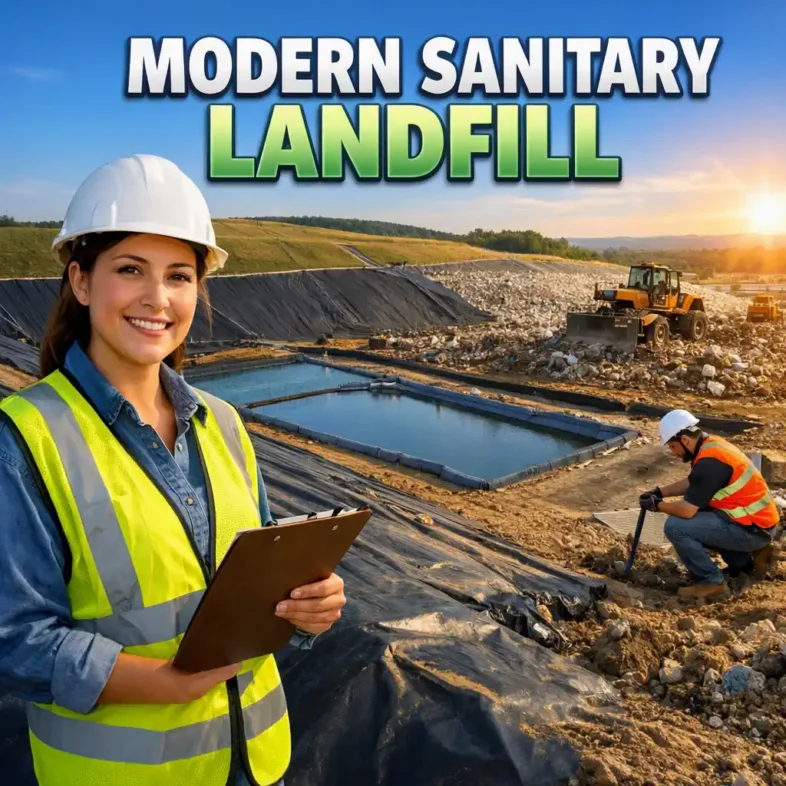
In the past. even in the developed nations, landfills had little to none of the sophistication of modern sanitary landfill design and environmental protection systems. For hundreds of years, the landfill worked like this: dig a hole, dump waste, cover it with soil, and hope for the best. It wasn’t environmentally responsible—it was just the only option we had.
Today’s sanitary landfills are radically different. They are engineered containment systems, not disposal grounds. They combine geology, chemistry, physics, and decades of operational discipline to isolate waste from people and the environment for many years.
But here’s the honest part: even at their best, modern sanitary landfills are a fallback position, not a destination.
This matters because you need to understand two truths at once. First, a well-designed modern sanitary landfill is far, far better than open dumping and genuinely protects public health and the environment. Second, the best waste systems don’t rely on landfills much at all. They prevent, reuse, recycle, and recover before they ever think about landfill.
Let’s walk through both truths.
Key Takeaways
- Modern sanitary landfills use engineered containment systems that include base liners, drainage layers, gas collection wells, and decades of environmental monitoring to protect groundwater and surface water.
- Leachate management is critical: Composite liner systems, collection pipes, and treatment prevent contaminated liquid from polluting groundwater. Leachate depth is usually kept below 30 centimetres on the liner, although up to 1 metre may be permitted.
- Methane capture is essential but imperfect: Landfill gas collection can reduce emissions by 70–90%, but some methane always escapes through covers, side slopes, and underground pathways. This is why diverting organic waste before landfilling matters.
- Aftercare extends decades beyond closure: Post-closure monitoring, gas management, and maintenance can continue for 30+ years (U.S.) to 100+ years (in some cases), reflecting the long timeline of waste stabilization.
- Well-managed modern landfills pose minimal health risk to nearby residents, but legacy and poorly managed sites remain concerning. Engineering standards, oversight, and accountability genuinely work.
- Zero waste to landfill is the better goal: Germany, the Netherlands, and the UK have demonstrated that waste systems can shift away from landfill dependence through prevention, recycling, composting, pre-treatment, and selective final disposal.
- Landfills have inherent limits: Leachate formation is inevitable, some methane always escapes, covers fail over time, and monitoring has blind spots. These aren’t engineering failures—they’re properties of waste disposal itself.
What Modern Sanitary Landfills Actually Are
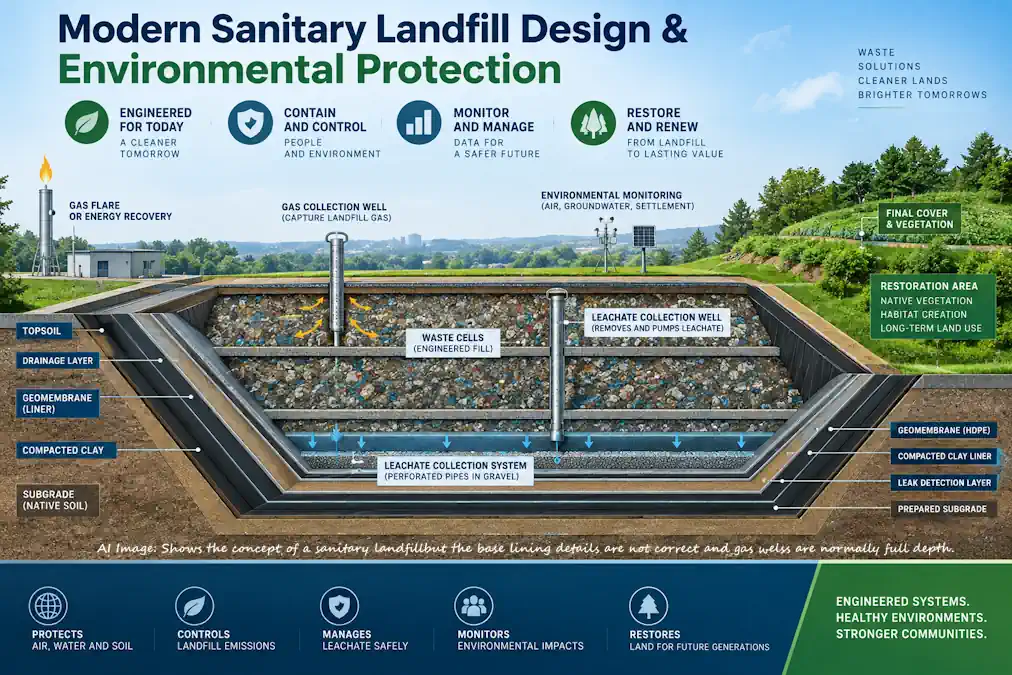
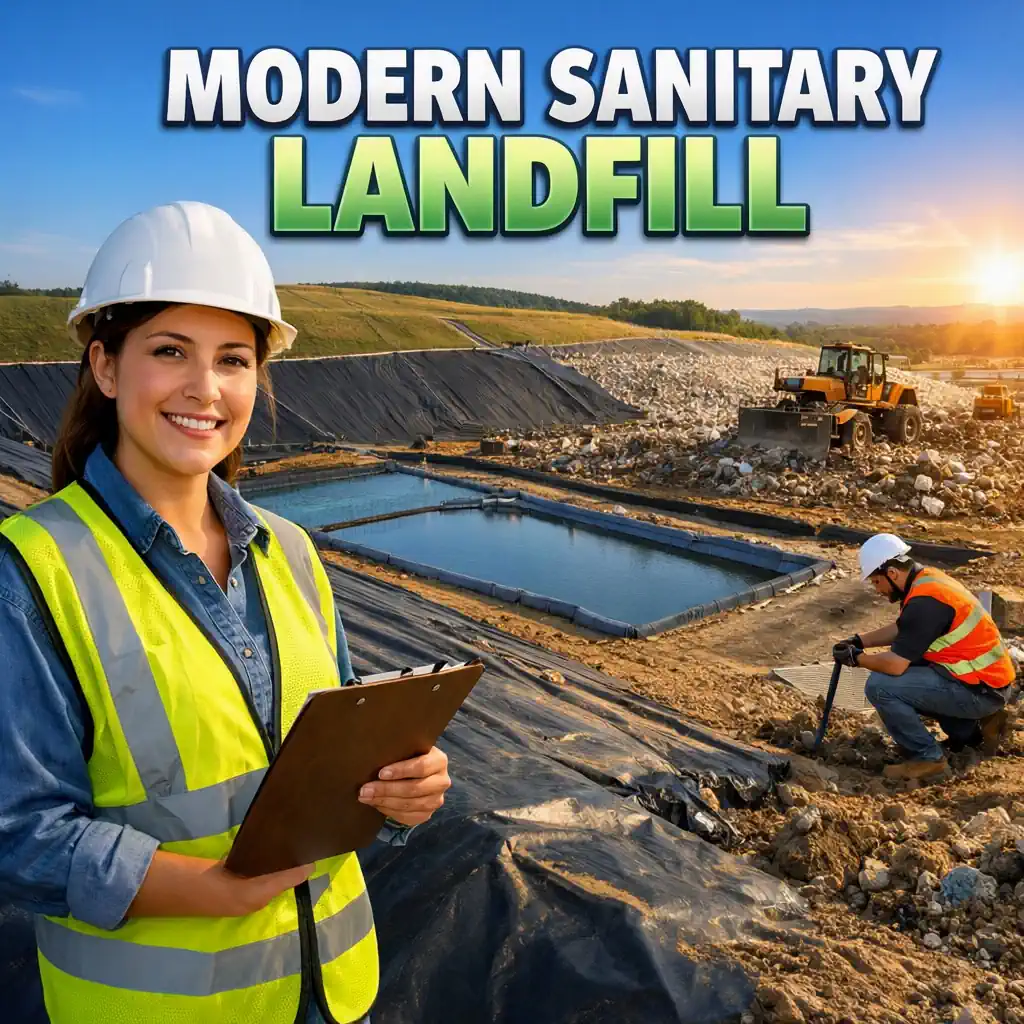
A modern sanitary landfill isn’t a simple pit. It’s a system with seven core engineered elements:
- Suitable site selection – geology, hydrogeology, and future land use all matter
- Engineered base and wall containment – liners, barriers, and drainage layers to prevent groundwater pollution
- Controlled waste placement – waste is placed in cells, compacted, and carefully sequenced
- Daily and intermediate covering – waste is covered to control odour, litter, and emissions
- Final restoration covering with surface water and water-ingress management
- Leachate collection and management – contaminated liquid is drained, treated, or removed
- Landfill gas collection and control – methane is captured, flared, or used for energy
- Long-term environmental monitoring – groundwater, surface water, and emissions are tracked for decades
Each element serves a specific environmental purpose. Remove one, and the whole system fails.
The philosophy is clear: a sanitary landfill is no longer just about burying waste. It’s about managing the physical, chemical, and biological behaviour of that waste over time while protecting everything around it.
How Protection Works: Five Key Environmental Systems
1. Leachate Containment and Water Protection
When rain falls on a landfill, it percolates through the waste and picks up contaminants. This becomes leachate—contaminated liquid that could seriously pollute groundwater, soil, and surface water if it escaped.
Modern landfill design prevents this through multiple layers:
Base liner systems typically include a geological barrier, geomembranes, protective geotextiles, and drainage blankets. In the United States, Subtitle D regulations establish baseline performance standards. The European Union, UK, and other jurisdictions have their own regulatory frameworks that specify appropriate containment systems based on landfill classification and site-specific conditions.
This isn’t one material doing the work. It’s a system. Each layer serves a purpose: one contains, one drains, one protects against puncture, one supports long-term stability. The exact combination and specifications depend on your jurisdiction’s regulatory requirements and your site’s hydrogeological conditions.
Leachate drainage is equally important. Pipes collect the contaminated liquid before it can build up and put pressure on the liner. If leachate sits at depth, it creates what’s called “hydraulic head”—the weight of liquid that can force contaminants downward into groundwater. Modern design keeps this to less than 30 centimetres.
The collected leachate is then pumped, stored, treated on site, or transported off site for professional treatment. This is managed continuously throughout the landfill’s active life and for many years after closure.
Monitoring boreholes are drilled around the landfill perimeter to detect any breakthrough. The U.S. EPA requires nearly all municipal solid waste landfills to monitor groundwater during active operations and for 30 years after closure. This isn’t an afterthought—it’s a legal obligation and an engineering safeguard.
2. Landfill Gas Collection and Methane Control
This is where modern sanitary landfills really diverge from older practice.
When organic waste decomposes without oxygen (anaerobically), it generates landfill gas—usually a mix of methane and carbon dioxide, with trace gases. Methane is the problem child: it’s flammable, can migrate through soil and find its way to buildings, and is a powerful greenhouse gas.
Here are the numbers:
- In the UK, landfill alone accounted for 55% of total waste-sector emissions in 2024.
- In the United States, municipal solid waste landfills are the third-largest source of human-related methane emissions, representing about 14.4% of total methane emissions in 2022.
- In Europe, solid waste disposal (mainly landfills) accounts for approximately 80% of methane emissions from the waste sector.
Modern landfills respond with gas wells and collection systems. Wells are drilled into the waste, connected to header pipes, and maintained at slight negative pressure to pull gas toward the surface. This gas is then either:
- Flared (burned to convert methane to CO₂, which is less potent)
- Used for energy (gas engines or turbines generating electricity or heat)
- Oxidized in cover soils (where some methane is broken down naturally)
The UK has demonstrated that this works profitably. For the last 30 years, landfill gas extraction has been financially viable because the wells and collection pipes are accounted for in landfill fees. The extracted gas is routinely used to generate electricity, making it a revenue stream.
But here’s the honest part: gas capture is never perfect. Methane can still escape through:
- Temporary caps during active filling
- Cracks in final caps due to settlement
- Side slopes and uncapped areas
- Poorly balanced extraction systems
- Underground migration pathways
This is why modern landfill design integrates gas collection with capping strategy, settlement management, and operational phasing. And it’s why measurement is becoming as important as collection. Recent UK government-backed research specifically focuses on improving methane measurement and metrics to help operators capture more and let less escape.
3. Groundwater and Surface Water Monitoring
Closure is not the end. It’s the beginning of aftercare.
After a landfill stops accepting waste, environmental responsibility doesn’t disappear. Contaminated liquid can continue to drain. Gas can continue to generate. Covers can fail. Settlement continues.
That’s why modern regulation mandates decades of monitoring. Boreholes around the perimeter are sampled regularly. Surface water quality is tracked. Gas emissions are measured. Settlement is monitored.
In a 2024 UK health review, regulators drew a clear distinction: well-managed active sites do not pose significant health risk, but older, poorly controlled legacy sites remain problematic decades after closure. Some historic landfills still emit gases and vapours 20 or 30 years after filling stopped.
This contrast is crucial. It shows that engineering standards, oversight, and long-term accountability actually work. A landfill built and operated well is very different from one that isn’t.
4. Cover, Capping, and Stability
Daily cover—placing soil or approved material over waste at the end of each operational day—sounds simple. It’s not.
It controls odour, birds, insects, rodents, and litter. It reduces fire risk. It’s operationally essential. But the real power is in final capping, which is designed to:
- Reduce water infiltration
- Support long-term gas control
- Minimize emissions
- Provide a stable surface for restoration
- Support vegetation and habitat
- Accommodate settlement without cracking
Modern cap systems are engineered as part of the whole containment design. They’re not just soil. They may include geosynthetics, drainage layers, gas venting routes, and materials chosen for their long-term stability.
The cover system works as part of a complete environmental control package, not in isolation.
5. Aftercare and Long-Term Responsibility
A landfill’s active life might be 20 or 30 years. Its environmental responsibility often lasts 100 years or more.
Post-closure care typically includes:
- Leachate pumping and treatment
- Gas extraction, flaring, or energy use
- Groundwater and surface water monitoring
- Cap repairs and drainage maintenance
- Settlement surveys
- Vegetation management
- Regulatory reporting and compliance
This isn’t a burden imposed by rules. It’s a reflection of landfill reality: waste stabilization is slow, settlement continues, and environmental risk remains measurable for decades.
Modern landfill design accounts for this from the beginning. Designers plan for aftercare, budget for it, and build it into the engineering.
The Real Strength: Engineering Excellence
When done well, modern sanitary landfills genuinely protect people and the environment.
The composite liner prevents most groundwater pollution. Gas collection reduces methane emissions substantially. Leachate treatment removes contaminants. Monitoring detects problems early. Multi-decade aftercare ensures ongoing protection.
Germany is the proof. In 2005, Germany phased out landfilling of biodegradable and organic waste, requiring pre-treatment in incineration or mechanical-biological treatment plants. The result? Germany now landfills less than 1% of its municipal waste, and the environment ministry reports that the ban “permanently prevents the creation of climate-damaging landfill gas and polluted seepage.”
The United States standardized landfill engineering through the Resource Conservation and Recovery Act (RCRA) Subtitle D framework, creating consistent performance expectations across states. The UK evolved toward highly regulated containment and aftercare practice, with the Environment Agency requiring landfill design to prevent unacceptable discharges and emissions over the site’s entire lifecycle.
These systems work because they’re based on decades of experience, monitoring data, and continuous improvement.
The Honest Limits: Why Landfills Will Always Be Imperfect
But—and this matters—no landfill is perfect.
Even in the world’s most advanced systems, some leachate will escape. Some methane will migrate. Some monitoring will miss emerging problems. Some covers will fail. Some sites will encounter unexpected groundwater or geological conditions.
A 2024 UK health review put it bluntly: while “living close to a well-managed landfill site does not pose a significant risk to human health,” there is “some evidence around respiratory effects and stress-related impacts” near poorly managed or older sites.
Here’s why landfills have inherent limits:
Inefficient Use of Finite Mineral Resources: They are ultimately unsustainable. By burying earth’s resources they would over a long period of time lock up all the precious resources needed by future populations. Landfill mining may release these resources again, but landfill mining is inefficient and environmentally damaging.
Leachate will always form. Rain will fall on the waste. Decomposition will release water. Unless you eliminate rainfall entirely (impossible), leachate is inevitable. You can manage it brilliantly, but you can’t eliminate it.
Methane generation is irreducible. If organic waste decomposes anaerobically, it makes gas. You can capture 70%, 80%, maybe 90% of it under ideal conditions. But some will always escape. And even small amounts of a powerful greenhouse gas matter in the context of climate change.
Covers fail over time. Soil settles. Geomembranes can crack. Clogging occurs. Roots penetrate. Over 100 years or more, degradation is inevitable. Post-closure care extends the timeline, but it doesn’t make landfills forever-safe.
Monitoring has limits. You can’t monitor every cubic meter. You can only sample at strategic points. Aquifers are huge; boreholes are tiny. Problems can lurk between monitoring points.
Settlement creates risks. As waste decomposes and consolidates over decades, the landfill surface subsides. This creates slopes, cracks, and areas of poor drainage. Differential settlement can rupture caps and drainage systems.
Long-term institutional memory is uncertain. A landfill’s aftercare obligation lasts 100+ years. Do regulators, funding mechanisms, and institutional knowledge persist that long? History suggests it’s harder than we’d like to admit.
These aren’t criticisms of modern landfill engineering. They’re inherent properties of waste disposal. They’re why even the best landfill is a backstop, not a solution.
Why Zero Waste to Landfill Is Still the Better Goal
This is the key insight: modern sanitary landfills are excellent at what they do. But what they do is manage a problem, not solve it.
The real solution is preventing the problem from existing in the first place.
Zero waste to landfill doesn’t mean zero waste generation. It means:
- Preventing unnecessary waste through smart design and consumption
- Reusing products and materials where possible
- Recycling materials into new products
- Composting and anaerobically digesting organic wastes
- Recovering energy from materials that can’t be recycled
- Only landfilling residues that cannot be managed any other way
Germany demonstrates this is realistic. The Netherlands shows how landfill bans and taxation can work. Japan’s Fukuoka Method proved that landfill behaviour can be optimized through design innovation.
When you shift thinking from “landfill is the answer” to “landfill is the last resort,” everything changes.
Waste streams become more carefully designed. Material recovery improves. Organic waste is diverted before it reaches the landfill (eliminating methane generation at source). Industrial processes become more circular.
The landfill’s role shrinks to what it should be: a controlled disposal point for residues that are genuinely unavoidable.
A Global Shift in Perspective
This isn’t theoretical. It’s happening now, in leading economies.
In the European Union, a decades-long process beginning with the original landfill directives is actively diverting waste away from landfills. Many EU nations now landfill less than a third of their municipal waste, with the goal of limiting municipal waste landfilled to just 10% by 2035.
In Germany, the 2005 landfill ban on biodegradable and organic waste redirected entire waste streams into incineration, mechanical-biological treatment, and composting. The result is transformation: less than 1% of municipal waste is landfilled.
In the Netherlands, a landfill ban on combustible and biodegradable waste (in place since 1995) combined with landfill taxation created an economic disincentive to landfilling. Mixed municipal waste cannot legally be sent to landfill.
In the United Kingdom, biodegradable municipal waste to landfill has fallen from 6.3 million tonnes in 2022 to 5.3 million tonnes in 2023—a 16% reduction in one year.
In the United States, while high standards exist under RCRA, there’s no unified policy of moving away from landfills. State regulations vary, and the gap between U.S. practice and the rest of the developed world is widening.
The global message is clear: modern sanitary landfills are necessary for now, especially in regions still transitioning from open dumping. But they are not the destination for good waste management. They are the fallback.
What This Means for Business and Policy
If you operate a facility, manage waste, or set sustainability goals, the implications are practical:
1. Invest in landfill diversion. Recycling programs, composting systems, and material recovery initiatives reduce what reaches the landfill—and they make economic sense.
2. Pre-treat before landfilling. If something must go to landfill, pre-treat it if possible. Segregate recyclables, compost organics, recover energy. Residues should be truly residual.
3. Choose landfills carefully. If landfill is necessary, use facilities that are engineered, permitted, and actively monitored. Legacy sites and poorly managed facilities are genuinely risky. Modern ones are not.
4. Plan for aftercare liability. Even well-run landfills have post-closure obligations. Build financial and operational contingency into long-term planning.
5. Track real environmental impact. Modern landfills can measure leachate quality, gas capture, and emissions. Use that data to make continuous improvements.
6. Design for circular economy. Ask “what should not come to landfill at all?” before asking “how can we landfill this better?”
The Bottom Line
Modern sanitary landfill design is genuinely impressive. The combination of engineering, monitoring, and regulatory oversight protects groundwater, captures greenhouse gases, and prevents the public health disasters that open dumping creates.
But landfills are tools for managing a problem, not tools for solving it.
The better goal—the one that leading economies are pursuing—is a waste system that doesn’t generate huge landfill streams in the first place. A system built on prevention, recovery, and circular thinking, with landfill as a truly final resort for residues that can’t be managed better.
That shift is already underway. Germany did it. The Netherlands did it. The UK is doing it. It’s possible, it’s economically viable, and it’s increasingly becoming the standard expectation.
So yes, support modern sanitary landfill engineering. It matters, especially in regions transitioning from open dumping. But also support and invest in the systems that make landfills less necessary.
That’s the real environmental progress.
Frequently Asked Questions
Q: Are modern landfills safe to live near?
A: Well-managed, permitted modern landfills do not pose significant health risks to neighbours, according to 2024 UK health reviews. However, legacy sites and poorly managed landfills are more concerning. Proximity to older sites should be evaluated carefully. The key factor is regulatory oversight, engineering standards, and active operational management.
Q: Can landfill gas be completely captured?
A: No. Modern systems capture 70–90% under ideal conditions, but some methane always escapes through covers, side slopes, cracks, and complex underground pathways. This is why diversion of organic waste before landfilling is important—it prevents methane generation at the source rather than trying to capture it after the fact.
Q: How long is a landfill environmentally monitored after closure?
A: Typically 30+ years under U.S. EPA requirements, often longer in Europe. The UK requires monitoring to continue as long as environmental risk exists, which can extend 100 years or more. Aftercare is not optional—it’s a regulatory obligation tied to landfill permits and financial assurance requirements.
Q: Is landfill gas profitable?
A: Yes, in developed economies. Gas extraction generates electricity or heat; revenue from energy sales often offsets collection costs. In the UK, gas extraction has been profitable for 30 years because the wells and collection infrastructure are accounted for in landfill gate fees. This financial viability is one reason why modern landfill gas management systems are so well-maintained.
Q: Why don’t all countries ban landfilling like Germany and the Netherlands?
A: Transition requires investment in recycling infrastructure, composting systems, energy recovery facilities, and policy enforcement. Lower-income countries often lack the financial resources and institutional capacity; higher-income countries sometimes lack the political will or long-term commitment. Germany and the Netherlands invested decades and substantial public funding to achieve their current systems. It’s possible but not quick or inexpensive.
Want to Go Deeper?
This article covers the essentials, but sanitary landfill design is complex and deeply technical. If you’re responsible for landfill operations, facility management, waste policy, or environmental compliance, there’s much more to understand about site selection, leachate management, gas optimization, settlement modelling, regulatory pathways, and aftercare strategy.
“What Is a Sanitary Landfill? A Modern Beginner’s Guide to Engineered Waste Disposal” is a comprehensive resource created by Steve Last, a Chartered Civil and Environmental Engineer with decades of experience in landfill design, leachate treatment, and gas management.
The guide covers:
- How modern sanitary landfills really work (beyond the basics)
- Site selection criteria and hydrogeological assessment
- Containment system design and performance
- Leachate and gas management strategies
- Operational phasing and airspace planning
- Closure, capping, and long-term aftercare
- How leading countries (Germany, Netherlands, UK, Japan, US) approach landfill differently
- Practical design checklists for teams and junior designers
- Real case studies and common beginner mistakes
Whether you’re a facility manager, sustainability professional, engineer, or policy maker, this guide provides the depth you need to make informed decisions about landfill use in your operations.
Get the Complete Guide and understand modern landfill design with the confidence and technical knowledge that comes from decades of real-world experience, or read the review of this ebook here.

Zero Waste Event Checklist: Step-by-Step Guide for Corporate & Festival Planners
Your board and sponsors want proof that zero waste is more than a slogan. This Zero Waste Event Checklist starts with one target: at least 90% diversion, with 10% or less sent to landfill. The steps run in this order. Choose reuse-first suppliers and put the rules in their contracts. Place matched compost, recycling and […]
Innovative Waste Management Ideas: Transforming The Future Of Waste Disposal
Everyone wants to live in a clean world, but rubbish makes it hard. We know that smart ways to handle waste can change the future. Innovative waste management leverages advanced technology and circular economy models to minimize landfill usage and reclaim valuable resources. Key trends include AI-powered sorting facilities, smart IoT bins for optimizing collection […]
Old Electronics Recycling: How To Responsibly Dispose Of Unwanted Devices
You probably have at least 25 unused electronic devices sitting in drawers or cupboards right now. Most households do because most neglect their old electronics recycling. And most people have no clear plan for what to do with their old electronic devices when they go wrong.. Here’s the key issue: those devices aren’t just clutter. […]
Waste To Energy: A Blind Spot In Global Methane Policy? The Waste Sector’s WtE Debate
You can see why waste-to-energy (WtE), often just known as “incineration”, has become a blind spot in methane policy. The toughest part of municipal solid waste management is rarely the clean paper, glass, or metals that people picture when they think about recycling; it is the messy residual waste left after sorting. Maybe most of […]