
Rugged moulded plastic bin-style construction waste containers (ranging from 75L to 167L) are the top choice for durability in smaller, high-traffic US construction environments, and RoRo (Roll-on, Roll-off) containers (20–60 yards) are the industry standard for large-scale demolition and heavy waste disposal.
A Mini Summary of this Article on Best Construction Waste Containers
- Choosing the incorrect container size is a leading cause of construction projects exceeding their waste disposal budget — choosing the correct size will save on the number of trips required for hauling, prevent fines for overflow, and ensure your site remains compliant.
- Roll-off dumpsters, which range in size from 10 to 40 cubic yards, are the most versatile option for most construction sites. However, specialised containers are necessary when dealing with hazardous materials such as asbestos, chemicals, or e-waste.
- Recycling dumpsters can significantly reduce your disposal costs — separating concrete, metal, and wood from general waste can lower landfill fees and may even qualify your project for material rebates.
- Front-load and rear-load dumpsters perform better than roll-offs in tight urban sites where space is limited and waste volumes are continuous rather than concentrated.
- Continue reading to discover which container type is best suited to your specific debris, project scale, and local regulations — getting this wrong can lead to fines, hazards on your site, and costly delays.
Choose the incorrect container and you'll end up paying for it twice — first in rental fees and then in hauling overages, fines, or project slowdowns.
No matter if you're tackling a complete commercial demolition or a simple home renovation, the container you choose has a significant impact on how efficiently waste is removed from your site. Bunkeh Builds provides detailed coverage of construction management topics, and choosing the right waste container is one of the most essential decisions a site manager can make. Make the right choice, and everything that follows becomes simpler.
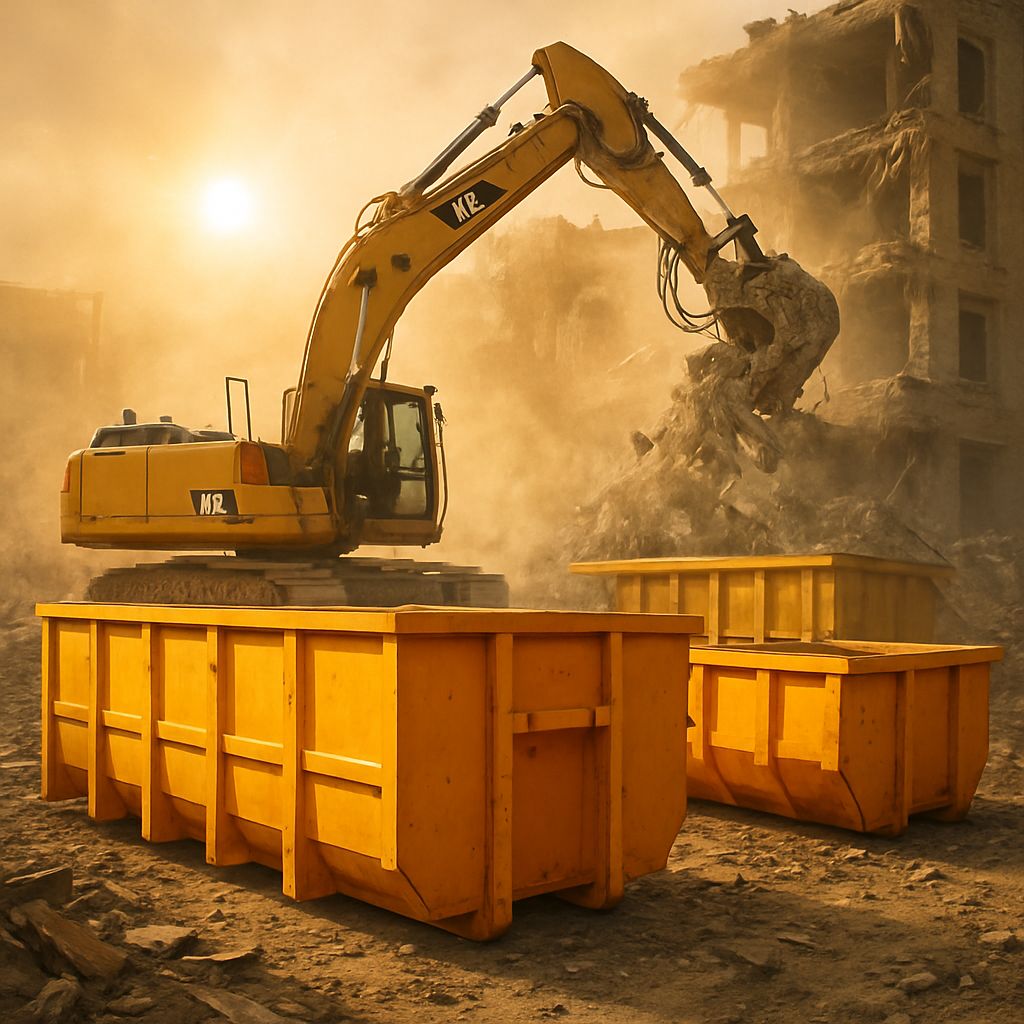
Choosing the Correct Container is Key to Effective Waste Management
Construction waste is more than just a nuisance — it's a potential danger. Debris that accumulates on site can lead to trip hazards, obstruct equipment movement, and attract regulatory attention. The container you rent or purchase plays a crucial role in how well your entire waste stream is managed from the beginning.
The Hidden Costs of Inadequate Waste Disposal
Project managers tend to focus on the cost of materials and labor when creating a budget. The cost of waste disposal is often underestimated until the bills start rolling in. If your dumpster is too small, you'll end up having to pay for emergency pickups, which can be quite expensive. If your container is too full, you could be hit with weight violation fees when it's time to haul it away. And if you accidentally put hazardous materials in the wrong bin, you could be facing hefty fines from the EPA, which could be much more than the cost of the container itself.
According to the Construction and Demolition Recycling Association (CDRA), proper waste management can drastically cut down on overall project expenses and increase recycling rates. This isn't just a theory — it's a fact that you'll see reflected in your project's bottom line.
The Impact of Container Selection on Job Site Safety and Productivity
Choosing the wrong container is not only costly, it's hazardous. When bins are overloaded, they become unsteady. Workers who have to maneuver around improperly positioned containers are more likely to get hurt. By choosing the right container, positioning it correctly, and ensuring it's the right size, you can keep your job site running smoothly and your team safe. For more information on proper waste management techniques, explore the RAMP method of waste disposal.
Real-World Example: A mid-size commercial renovation project produces an estimated 4 to 8 pounds of waste per square foot of construction. A 5,000 sq ft project could yield up to 40,000 pounds of waste. Without an adequate container solution — typically a 30 or 40 cubic yard roll-off — that volume necessitates multiple emergency hauls, costing significantly more than planning ahead with the right container size from the start.
Efficiency is achieved by planning the waste stream before the first shovel hits the ground. Understand your debris types, estimate your volume, and match the container to the job — not the other way around.
Roll-Off Dumpsters: The Backbone of Construction Waste Management
When it comes to construction sites nationwide, one type of container reigns supreme: the roll-off dumpster. These open-top containers are delivered flat on a truck and then rolled directly onto your site. They can handle just about any type of debris and come in a variety of sizes to suit your project needs.
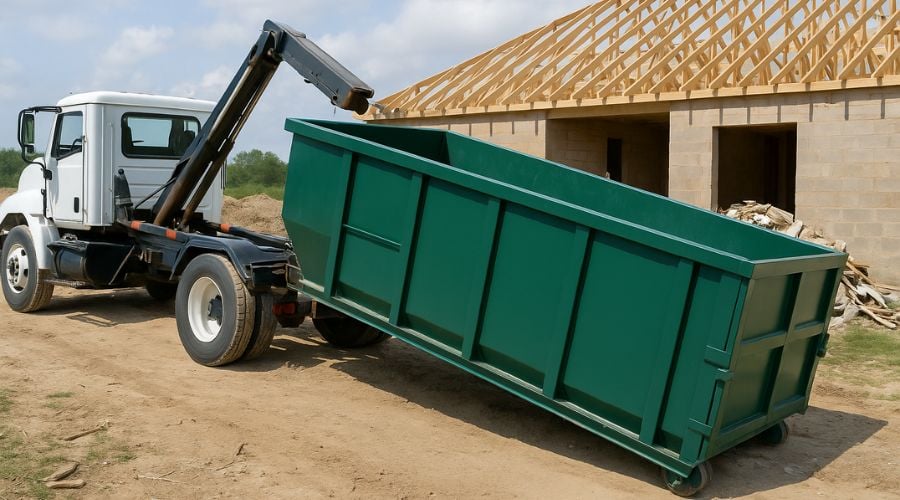
“Roll Off Dumpster Sizes: Everything You …” from www.360connect.com and used with no modifications.
Understanding Capacity Options From 10 to 40 Cubic Yards
Roll-off dumpsters typically come in four sizes: 10, 20, 30, and 40 cubic yards. A 10-yard dumpster is perfect for small cleanouts or single-room renovations. A 20-yard container is suitable for mid-size remodels and roofing tear-offs. The 30-yard option is great for larger renovation projects and new home builds. And the 40-yard dumpster — the largest standard size — is designed for full commercial demolitions, large-scale construction, and industrial debris removal.
Most people underestimate the importance of selecting the right size of construction waste containers. The National Waste and Recycling Association (NWRA) points out that choosing the right dumpster size can significantly increase productivity on the job site by reducing unnecessary haul cycles and preventing overflow on the site.
Open-Top Structure Construction Waste Containers and Door Entry for Large Waste
The open-top structure isn't just for ease of use — it's made for the practicality of construction waste. Long pieces of wood, sheets of drywall, old roofing materials, and shattered concrete don't fit well into enclosed containers. Roll-offs accept all of these. Most also have a hinged back door or swing gate at ground level, so workers can carry heavy or awkward loads straight in instead of lifting them over the side.
Top Projects for Roll-Off Dumpster Use
Roll-off dumpsters are perfect for projects that generate a lot of debris at once. They're often used for roof replacements, complete home remodels, commercial buildouts, site clearing, and demolition work. If your project is going to generate most of its waste within a specific time frame, a roll-off dumpster that can handle that amount is usually the most cost-effective option.
Front-Load and Rear-Load Dumpsters for Compact Sites
There isn't always enough space on a construction site for a 40-yard container. Urban infill projects, interior commercial renovations, and phased builds frequently require a smaller footprint — and that's where front-load and rear-load dumpsters come in handy. For more information on effective waste management strategies, explore these UK solid waste management companies.
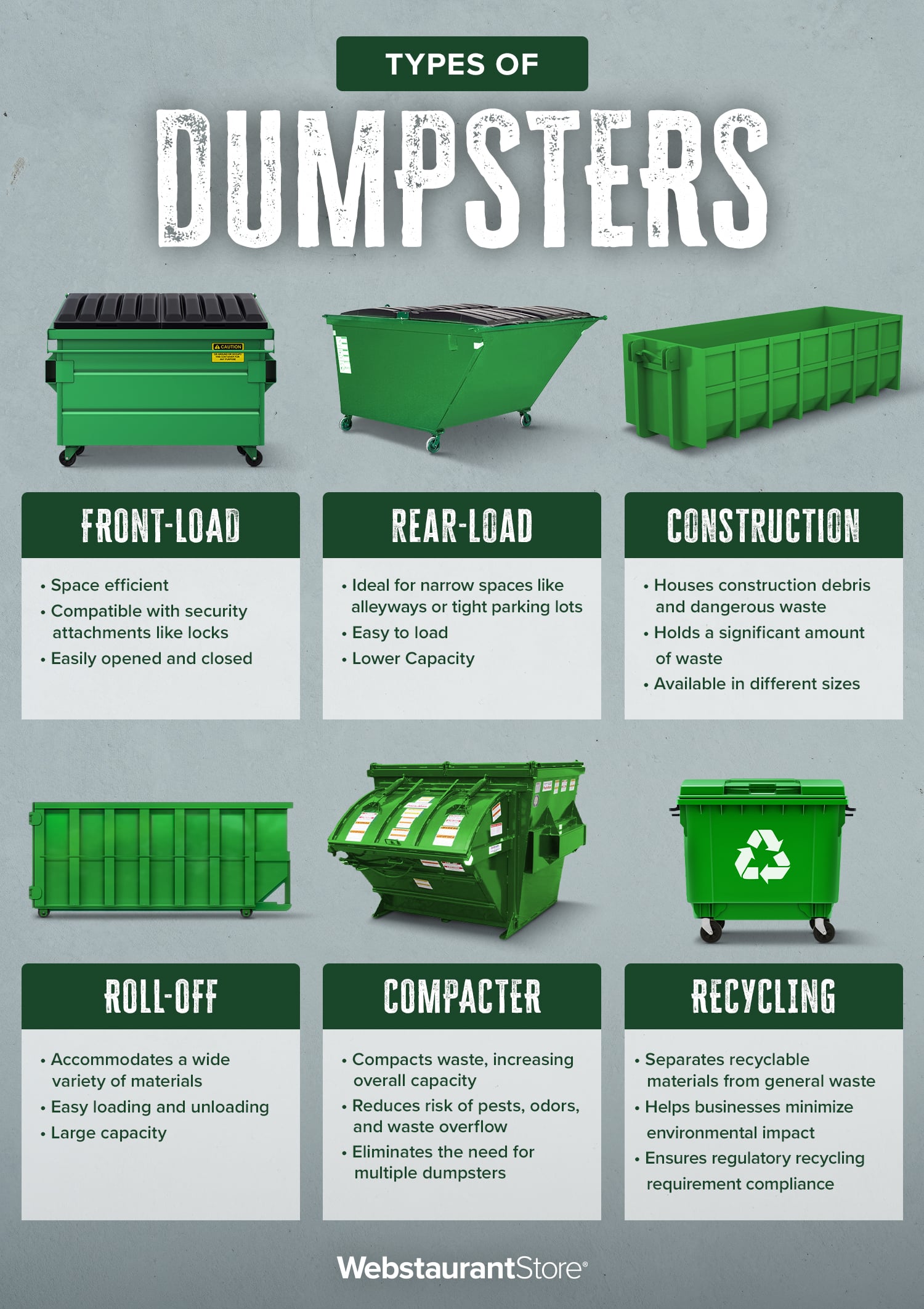
“Types of Dumpsters: Sizes, Styles …” from www.webstaurantstore.com and used with no modifications.
Why Front-Load Dumpsters Are the Best Choice
Front-load dumpsters are lifted by trucks equipped with hydraulic forks from the front, allowing them to fit into tighter spaces and be accessed from a service lane or alley. They come in a variety of sizes, from 2 to 8 cubic yards, making them an ideal choice for commercial construction sites where waste is generated consistently over time instead of all at once.
These containers are particularly useful for long-term projects that last several weeks or months and require routine scheduled pickups. Instead of having to make emergency haul requests when a roll-off becomes too full, you can establish a pickup schedule, and the container will be serviced on a rotational basis. This not only keeps the site cleaner, but it also reduces the amount of management required.
- 2-yard containers — Ideal for small retail remodels or interior demolition work
- 4-yard containers — Perfect for medium-sized commercial renovations with a moderate amount of daily waste
- 6-yard containers — Great for larger ongoing commercial or multi-unit residential construction projects
- 8-yard containers — Best for high-volume ongoing projects in locations with limited space
One of the main benefits is the flexibility in pick-up frequency. Front-load containers can be emptied daily, weekly, or on a custom schedule — which helps to avoid the overflow issues that often occur with poorly managed roll-offs on long-term projects.
Back-End Dumpsters: Benefits for Continuous Projects
Back-end dumpsters work in the same way as front-end ones, but they are serviced from the back of the truck. They are a dependable choice for locations where the service vehicle needs to come from a certain direction, or where loading access points are at the back of the site. For construction projects that are next to occupied buildings or in crowded city settings, back-end containers provide the same scheduled-service advantages with extra flexibility in placement and access. To ensure proper waste management, it's important to consider waste segregation practices.
Specialised Bins for Dangerous Construction Waste
Regular dumpsters can manage the majority of construction waste with no problem. However, when hazardous substances are involved, the regulations change completely — and the appropriate bin isn't a luxury, it's a legal necessity. For effective waste management, understanding the importance of waste segregation is crucial to ensure compliance and safety.
Asbestos Waste Containers: Double-Lined and Sealed for Your Protection
Asbestos is one of the most heavily regulated construction waste materials in the United States. You can't just throw it in a regular dumpster. Asbestos waste requires double-lined, sealed containers — usually heavy-duty polyethylene bags that are rated for asbestos disposal, which are then placed inside rigid sealed drums or dedicated asbestos waste bins. These containers must be clearly marked according to EPA and OSHA standards, and disposal must be handled by a licensed hazardous waste haulier. Don't take shortcuts — improper disposal can lead to federal penalties.
Chemical Waste: HDPE and Corrosion-Resistant Options
Construction sites often generate chemical waste, which is placed in appropriate construction waste bags — solvents, adhesives, paints, and cleaning agents that can corrode standard steel containers or seep into the ground if improperly stored.
High-density polyethylene (HDPE) containers are the industry standard for chemical waste on construction sites. HDPE is chemically resistant to a wide range of solvents and acids, won't rust, and maintains structural integrity even when exposed to harsh materials over extended periods. For sites dealing with mixed chemical streams, corrosion-resistant stainless steel containers are also a proven option.
Specialised Bins for Electronic and Battery Waste
As technology advances, more and more construction projects require the removal of electronic systems such as security systems, HVAC automation, lighting controls, and outdated wiring infrastructure. These systems contain heavy metals like lead, mercury, and cadmium, which are not allowed in most standard landfills. Specialised e-waste bins are necessary to keep these materials separate from general waste and ensure they are disposed of at certified electronics recycling centres. Lithium-ion batteries from cordless tools are also considered e-waste and should never be disposed of in a standard roll-off.
Save Money and the Environment with Recycling Dumpsters
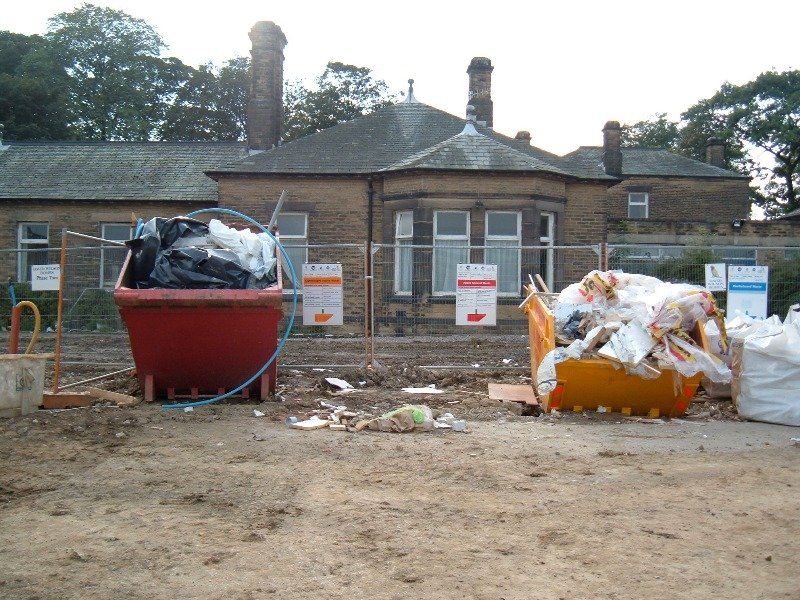
Many construction sites overlook a simple way to save money: source-separated recycling. Rather than dumping all waste into one container and paying fees based on the total weight, recycling dumpsters allow you to separate valuable materials from the waste stream. Not only does this reduce landfill waste, but it can also earn you money or lower your disposal fees.
What Materials Can Be Separated and Recycled On-Site
The most frequently recycled construction materials are:
- Concrete and masonry — Crushed and repurposed as road base or aggregate
- Clean dimensional lumber — Accepted by lumber recyclers and salvage yards
- Ferrous and non-ferrous metals — Steel, copper, and aluminium have strong scrap market value
- Cardboard and paper packaging — Diverted through standard recycling streams
- Drywall (unpainted gypsum) — Recyclable into new wallboard or agricultural soil amendment
- Roofing shingles — Accepted by asphalt recyclers for road paving applications
The key is keeping these streams separate from day one. Once concrete mixes with drywall scraps and general trash, the recyclability drops sharply and hauliers charge you full tipping fees on the entire load. For more tips on efficient waste disposal, check out our guide on construction roll-off dumpsters.
Cost Savings of Recycling vs. Traditional Disposal
By separating recyclable materials from your overall waste, you're reducing the weight you're charged to dump. Landfill tipping fees fluctuate based on location, but they typically range from $50 to $150 per ton.
For a large commercial project producing hundreds of tons of waste, the cost savings from recycling concrete, metal, and clean wood can be significant. Some metal recycling companies will even pay for scrap steel and copper, transforming a disposal expense into a small source of income.
High-Capacity and Compression Dumpsters for Large Construction Projects
For those times when a standard roll-off dumpster just won't cut it, high-capacity and compression dumpsters are ready to handle large volumes of dense waste. High-capacity dumpsters are made with reinforced steel walls and can handle more weight, which is essential when you're getting rid of concrete, brick, and tile that can quickly exceed a standard dumpster's weight limit.
Compression dumpsters take it up a notch by mechanically compacting the waste as it's loaded, which significantly increases the amount each dumpster can hold before it needs to be emptied. For large commercial construction or demolition projects where there's a constant stream of waste, compactors can decrease the frequency of hauls, lower the cost per ton of disposal, and keep the site cleaner between service cycles. The downside is that the equipment costs more upfront, but for projects that last six months or longer, it's usually more cost-effective to use compaction.
Hook-Lift Dumpsters: The Versatile Multi-Container Solution
Hook-lift dumpsters function on a system where a specialised truck employs a hydraulic hook arm to exchange containers in and out without the driver exiting the cab. This makes them extraordinarily quick to service — and it paves the way for operating multiple containers on the same site at the same time, each committed to a different waste stream.
- Quickly switch out containers without long truck delays
- Use separate containers for concrete, wood, metal, and general debris at the same time
- Adjust the number of containers as the project phase changes
- Available in a variety of sizes from small 3-yard bins to large 40-yard containers
- Ideal for sites with limited access where traditional roll-off trucks have difficulty maneuvering
The hook-lift system is especially effective on phased construction projects. During foundation work, you might use two containers specifically for concrete. As the project moves into framing and finishing, you change configurations to match the changing waste profile — all using the same hook-lift infrastructure.
If you're a general contractor juggling multiple sites, hook-lift systems let one truck service several locations in one go. This cuts down on transportation costs. So, it's not just a waste container solution, but also a logistics solution.
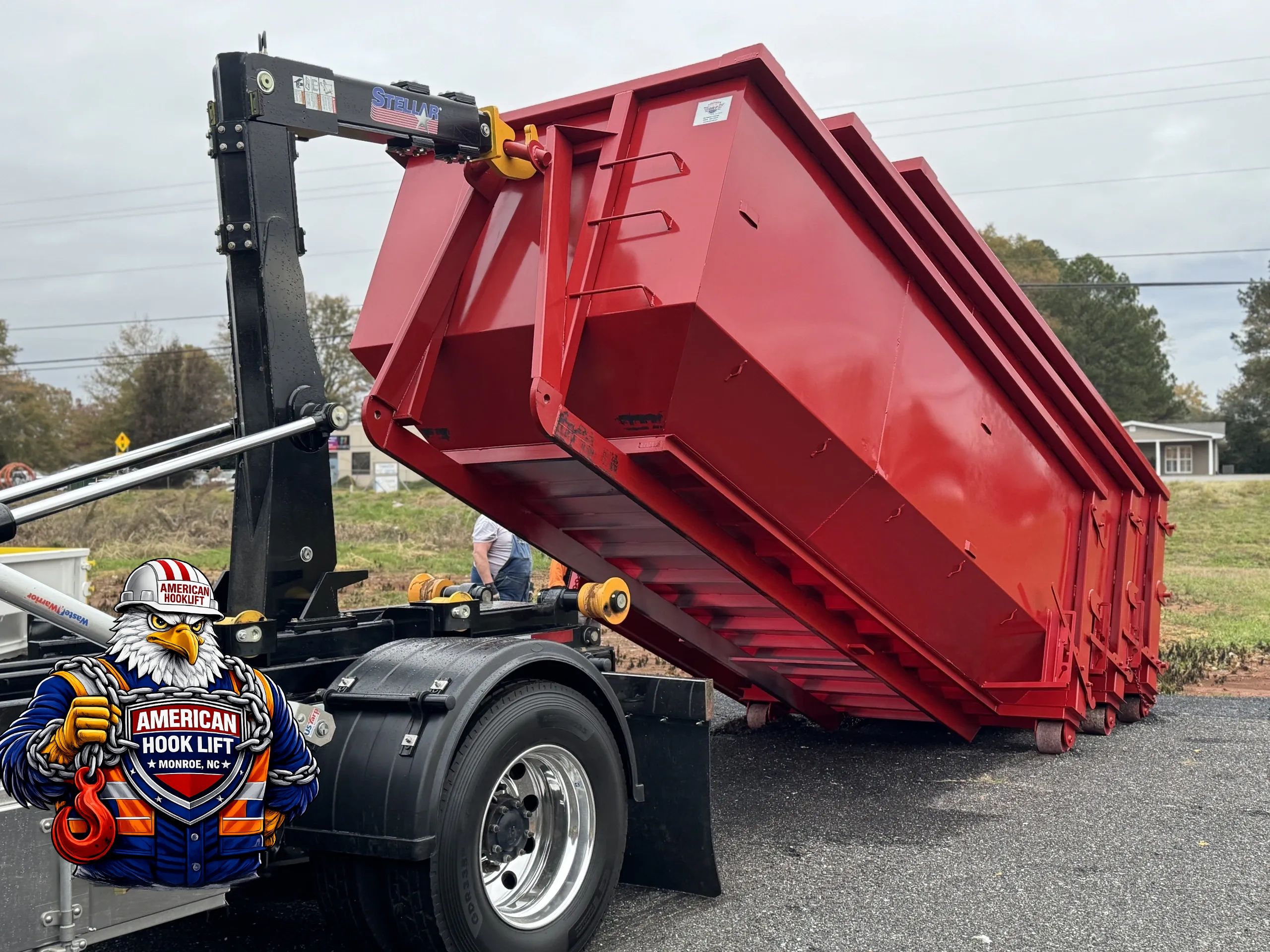
“Hook Lift Dump Truck” from americanhooklift.com and used with no modifications.
Choosing the Best Container for Your Needs
There are many different types of construction waste containers to choose from, and the best one for you will depend on the size of your project, the type of debris you're dealing with, and the regulations in your area. If you choose the right container, you won't have to worry about waste management. But if you choose the wrong one, you could end up with a big problem on your hands.
Before you rent anything, you should first estimate your total waste volume. You can get a working number to size your container against by giving a rough calculation based on the square footage of the project and the type of construction. It's almost always better to go one size larger than your estimate suggests — the cost difference between a 20-yard and a 30-yard container is typically minor compared to an emergency haul fee.
Choosing the Right Container Size for Your Project
| Type of Project | Suggested Container Size | Extra Info |
|---|---|---|
| Renovation of one room | 10 cubic yards | Perfect for light debris, drywall, and flooring |
| Remodelling an entire home | 20–30 cubic yards | Can handle a mix of heavy and light debris |
| Tearing off a roof | 20 cubic yards | Remember, shingles are heavy; don't overfill |
| Building a new home | 30 cubic yards | Will need to handle framing waste and packaging |
| Demolishing a commercial building | 40 cubic yards or multiple units | Consider using compactors for projects that last a long time |
The Type of Debris Determines the Material and Design of the Container
Heavy debris like concrete, brick, and tile requires reinforced construction waste containers with a high weight rating. If you load heavy materials into a standard roll-off that's rated for lighter waste, you risk structural failure and violations of hauling regulations. On the other hand, light mixed debris like drywall, insulation, and packaging doesn't require a heavy-duty build, but it does benefit from a larger volume container to avoid constant hauls. Hazardous materials always require containers that are purpose-built and compliant, regardless of volume. Make sure the container's structural rating and design match what you're actually going to put in it, not just its cubic yard capacity. For more information on container designs, check out some landfill examples and designs.
What Local Regulations You Need to Know Before You Rent
Local regulations for construction waste containers can differ greatly depending on the municipality, county, or state. Some jurisdictions require permits to place a roll-off container on a public street or even a private driveway. Others require specific recycling diversion rates for construction projects of a certain size. For instance, California's CalGreen standards mandate a minimum 65% diversion of construction waste from landfills for certain projects. Before you rent any container, make sure you know the local permitting requirements, confirm what types of waste are acceptable with your haulier, and check if your project falls under any state or local waste diversion mandates. If you skip this step, you could end up with a stop-work order or unexpected fines.
Best Practices for Disposing of Construction Waste
Merely having the correct construction waste containers on the job site is just part of the solution. The way you handle that container — from how you load it to when it gets picked up to making sure you're following the rules — is what makes or breaks whether your waste management system is effective or if it's just slowly eating away at your budget and creating liability. To ensure compliance and efficiency, understanding the inert waste acceptance criteria is crucial.
Arrange for Regular Pickups to Avoid Construction Waste Container Overflows and Safety Risks
A dumpster that's overflowing is not only unsightly, it's also a safety risk and a potential violation of regulations. Debris that spills over the sides can cause tripping and falling accidents, attract vermin, and in some areas, result in immediate fines from local code enforcement. Rather than sticking to a fixed schedule, arrange for pickups based on when your project is generating the most waste.
If you're in the midst of a high-output phase like demolition or framing, you might require hauls every two to three days. However, if you're doing finishing work, weekly pickups might be more than sufficient. Make sure you discuss flexible scheduling with your hauler in advance — most waste management companies are willing to adjust pickup schedules for projects without imposing significant cost penalties, as long as you arrange it in advance.
Start Recycling From the First Day of Construction
One of the biggest recycling mistakes made by construction teams is not thinking about recycling until the end of the project. By then, it's too late to recycle materials that are buried under layers of mixed waste. The best time to start recycling is when the material is first removed from the structure or packaging and can be placed in the correct container. For more information on effective recycling practices, check out our guide on waste segregation.
Make sure your containers are clearly marked. Using colour-coded lids, putting up signs on each bin, and taking five minutes to brief your team at the start of each phase of the project can make a big difference. The Waste Management Association points out that if you load and sort waste properly, you can increase the effective capacity of your containers by as much as 20%. That means fewer hauls and lower total disposal costs over the course of the project.
Commonly Asked Questions About Construction Waste Containers
Questions about construction waste containers arise on nearly every project, and the answers vary greatly depending on the type of project, the composition of the debris, and local regulations. Here are the most frequently asked questions — answered straightforwardly.
What Size Roll-Off Dumpster Do I Need for a Home Renovation?
For most home renovations, a 20-yard roll-off dumpster is sufficient for single-room to mid-size whole-home projects. If you're doing a full gut renovation on a larger home — stripping floors, walls, cabinets, and roofing — you may want to consider a 30-yard container. If you're unsure, it's better to size up. The cost difference is minor compared to an emergency haul fee when your 20-yard fills faster than expected.
Is it okay to put concrete and bricks in a regular roll-off dumpster?
Yes, but there's a crucial thing to keep in mind: concrete and masonry are very heavy, and most regular roll-off containers have weight limits. These limits usually range from 2 to 5 tons, depending on the size of the container and the haulier. If you fill a 20-yard dumpster only with concrete, you'll likely exceed the weight allowance before the container even looks full.
If you're working on a project that's producing a lot of concrete, brick, or tile, you'll want to ask for a construction waste container that's rated for heavy debris and specifically sized for dense materials. Many hauling companies offer 10-yard containers that are rated for heavy loads just for this purpose – you won't fill up as much space, but you'll stay within the legal weight limits for hauling, which can help you avoid expensive overage fees.
How Frequently Should Dumpsters at Construction Sites Be Cleaned Out?
The answer to this question is not one-size-fits-all. It relies heavily on the rate at which waste is produced. A demolition site that is bustling with activity may need to have the waste hauled away every two days. On the other hand, a crew finishing up on a residential project may only need pickups every two weeks. The ideal frequency is one that ensures your container is always 80% full or less, providing some leeway for sudden increases in debris.
It is best to plan for more frequent pick-ups during the periods of the project that will generate the most waste and decrease frequency during slower periods. You should coordinate with your haulier at the beginning of the project to establish a flexible schedule and have a point of contact for on-call pickups when the volume of waste unexpectedly increases.
What Are the Consequences of Placing Hazardous Waste in a Regular Dumpster?
There are severe consequences. If hauliers find hazardous materials in a standard dumpster — such as asbestos, solvents, lead paint debris, batteries, or regulated chemicals — they are legally obligated to reject the load. You will be charged a contamination fee, the dumpster remains on your property, and you will be responsible for organising compliant hazardous waste removal at your own expense. If the material makes it to a landfill and is found there, EPA enforcement can trace it back to your project. This can result in fines that are much higher than the cost of properly handling it in the first place.
Do Recycling Dumpsters Cost More Than Regular Construction Dumpsters?
Generally, in the realm of construction waste containers the rental price of a recycling dumpster is about the same as that of a regular roll-off dumpster. In fact, when you consider the lower tipping fees, the overall disposal cost of the project is often less. Landfill tipping fees are based on the total weight of your load. By separating heavy materials like concrete, metal, and clean wood into different recycling containers, you're taking out the heaviest, most expensive materials from your general waste stream.
While some recycling hauliers may charge more for picking up sorted material, this cost is often balanced out by the lower landfill costs for general waste. This is especially true for metals. Scrap steel and copper have a tangible market value. Some hauliers or recycling facilities will even give you a credit on your account or lower your hauling fees when you deliver clean metal in large quantities.
Simply put, recycling dumpsters are hardly ever more expensive in terms of total cost, and they're almost always less expensive for larger projects. The initial thought of extra cost quickly fades away when you examine the final disposal bill at the end of the project.
You would potentially also benefit from reading our page on Construction Waste here.
[Published 30 June 2014. Re-written 28 March 2026.]

Waste Segregation Benefits, Importance & Environmental Impact
Waste segregation transforms how we manage waste by sorting it into organic, recyclable, and hazardous categories. This practice reduces landfill use, cuts greenhouse gas emissions, and saves resources. Adopt these habits to mitigate environmental impact and take tangible steps towards sustainability in both residential and commercial settings…



My uncle is thinking about starting a project that will get rid of a lot of junk. It could be really nice for him to rent a container to get rid of the junk. Thanks for the tips about how most companies will be able to handle the waste that the project produces.
Where can I buy in India :
Hook lift roll off containers, (Ampliroll, Multilift, Stellar, Palfinger, Swaploader and other styles.)
Cable pull roll off containers, Dempster, or dual purpose roll off bins. The roll off/ lift off etc., type of containers can be used as waste containers for