The prohibition on waste disposal units in UK commercial kitchens marks a decisive change in food service regulation. Effective from 31 March 2025, this ban applies to restaurants, hotels, schools, hospitals, and every commercial catering facility operating across England.
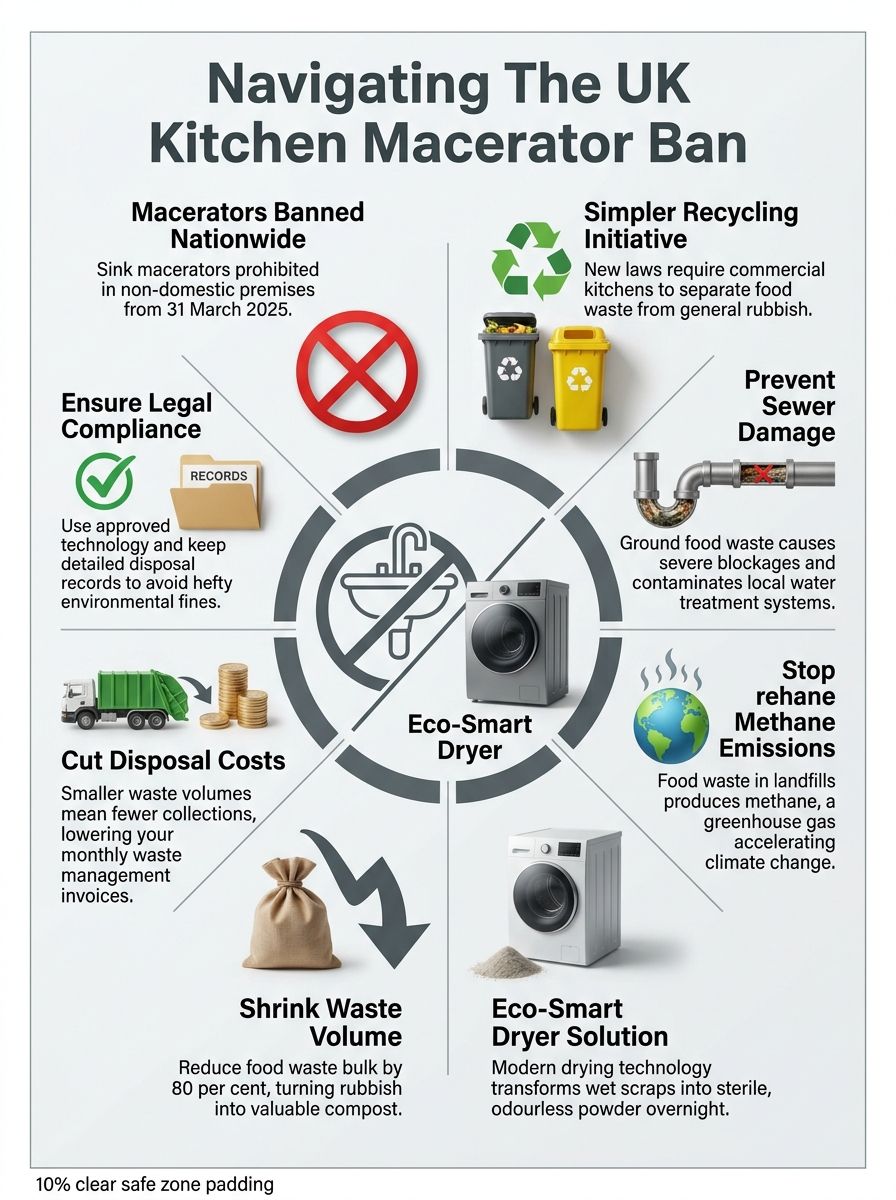
For years, sink macerators provided a convenient solution: grind food scraps and flush them into the drainage system. The Simpler Recycling initiative has ended that approach entirely.
The legal basis rests on two key pieces of legislation. The Environment Act 2021 and the Water Industry Act 1991 together require businesses to separate solid food waste and route it through licensed collection and treatment services, not into sewers.
The environmental and financial stakes are significant. Food waste decomposes in landfills without oxygen, generating methane at a rate that far outpaces the warming effect of carbon dioxide. Every commercial kitchen that continues to rely on outdated disposal methods contributes directly to that damage.
This article explains the regulations behind the ban, the environmental case against macerators, and the practical alternatives available to commercial kitchens. It also covers the financial implications of non-compliance and examines the Eco-Smart Food Waste Dryer as a proven, compliant solution with documented results from NHS Lothian's installation at St. John's Hospital.
Key Takeaways
- The UK government banned sink macerators in commercial kitchens from 31 March 2025 under the Simpler Recycling Initiative to protect water systems and reduce landfill methane emissions.
- Food waste decomposing in landfills produces methane gas, which traps heat 25 times more effectively than carbon dioxide, accelerating climate change significantly.
- The Eco-Smart Food Waste Dryer reduces food waste volume by up to 80 per cent, cutting disposal costs and lowering commercial kitchens' carbon footprints substantially.
- Businesses must separate food waste from general waste, use licensed collection services, and keep detailed records to comply with UK environmental regulations and avoid hefty fines.
- NHS Lothian installed the Eco-Smart Food Waste Dryer at St. John's Hospital, demonstrating how commercial kitchens transform waste into resources that support circular economy practices.
UK Government Regulations on Waste Disposal Units
UK law bans waste disposal units in commercial kitchens to protect water systems and reduce strain on sewers. The Environment Act 2021 and the Water Industry Act 1991 set strict rules that businesses must follow to manage food waste properly.
Why are sink macerators banned in commercial kitchens?
Sink macerators, also known as waste disposal units or liquidizing digesters, face strict bans across UK commercial kitchens due to serious environmental concerns. These machines grind food waste into small particles that flow down kitchen sinks and into sewers.
The Environment Act 2021 and the Water Industry Act 1991 drive these restrictions because macerators create significant problems for water treatment systems. Food waste particles cause sewer blockages, damage infrastructure, and contaminate water supplies.
Operators like Insinkerator and Wastemaid produced these units for years. Their use now conflicts directly with modern waste management goals, and the ban reflects a shift to proper food waste separation and recycling rather than flushing organic matter into sewers.
Food waste disposed of through macerators eventually reaches landfills, where it produces methane. This potent greenhouse gas drives climate change. The Simpler Recycling Initiative and current recycling laws now require businesses to handle solid food waste responsibly through composting, anaerobic digestion, or industrial composting facilities.
Commercial kitchens must use dewaterers and food waste collection services instead, which capture nutrients for renewable energy production. This shift protects marine ecosystems from pollution, reduces carbon dioxide emissions, and supports the circular economy.
Businesses that comply with these regulations demonstrate a genuine commitment to environmental sustainability whilst avoiding hefty fines under environmental sentencing guidelines. First Mile and similar collection services now partner with commercial kitchens to ensure food waste reaches proper treatment facilities rather than landfills or sewers.
What is the Simpler Recycling Initiative?
The UK government created the Simpler Recycling Initiative to transform how commercial kitchens handle food waste recycling and business waste management. This government-led effort makes food waste separation and collection mandatory in commercial settings across the country.
According to the UK Government's Simpler Recycling compliance guidelines, all English businesses with ten or more full-time employees were required to separate all food waste from 31 March 2025, regardless of the volume produced. Micro-businesses have until 2027 to comply, but no commercial kitchen is exempt from the direction of travel these rules set.
Businesses must now follow strict guidelines for food waste recycling, which means they cannot use traditional waste disposal units like sink macerators. Water UK and CEDA work together to support this initiative, ensuring that commercial kitchens meet the new standards.
- All food waste must be separated from general waste before collection.
- Businesses must use approved recycling methods aligned with the waste hierarchy.
- RecycleID™ and similar tracking systems help businesses demonstrate compliance.
- Franke and other equipment manufacturers produce machines that align with these requirements, including systems that separate fats, oils, and grease from other waste streams.
Northern Ireland and other UK regions started in 2025, implementing these rules in commercial food preparation areas. The initiative marks a clear step toward a greener, resource-efficient future for the food service industry and the marine sector alike.
What is the environmental impact of food waste?
Food waste creates serious environmental damage when it ends up in landfills, where it breaks down and releases harmful gases into the atmosphere. According to updated data from the Waste and Resources Action Programme (WRAP), the UK hospitality and food service sector generates over one million tonnes of food waste every year, with approximately 75 per cent of that waste being entirely avoidable. The way this waste is disposed of matters far more than most people realise.
How does food waste produce methane in landfills?
Decomposing food waste creates a serious problem in landfills across the UK. Landfill sites lack oxygen, which means food scraps break down through anaerobic decomposition rather than normal rotting.
This process releases methane gas, a potent greenhouse gas that damages the environment far more than carbon dioxide. Methane carries over 25 times the warming potential of carbon dioxide, making it a major threat to our climate.
Tonnes of organic material end up in UK landfills each year, creating vast quantities of methane that escape into the atmosphere. Restaurants, hotels, and catering businesses generate enormous amounts of food waste daily, and most of this waste has traditionally travelled to landfills.
The business waste and recycling sector recognises how significant methane emissions from landfills are to global warming. Switching to sustainable disposal methods prevents methane production, protecting the environment for future generations.
Why is environmentally responsible treatment important?
Treating food waste responsibly delivers real, measurable benefits for the environment and for business operations. Landfills produce methane when food breaks down without proper care. Responsible treatment eliminates that risk at the point of disposal.
Responsible treatment of food waste enables renewable energy production through anaerobic digestion, which transforms waste into usable power. Recycling food waste promotes a circular economy and reduces reliance on landfill, cutting the amount of material buried each year.
- Businesses that manage food waste properly lower their carbon emissions significantly.
- Organic material diverted from landfill can generate energy and nutrients for new crops.
- Responsible disposal improves air quality by preventing methane release.
- Organisations that adopt these practices demonstrate genuine commitment to sustainability.
Your kitchen can stop sending tonnes of organic material to landfills. Instead, that waste becomes a resource. The shift toward responsible treatment builds a more sustainable future for the entire food service sector.
Sustainable Alternatives to Traditional Macerators
The UK commercial kitchen sector now demands fresh approaches to food waste management. Modern solutions replace outdated macerator systems with smarter technology. Businesses can use food waste dryers and composting systems that handle organic matter far more effectively than traditional sink units ever could.
What is the Eco-Smart Food Waste Dryer?
The Eco-Smart Food Waste Dryer is a practical solution for commercial kitchens seeking to manage food waste responsibly. This device operates overnight, transforming wet food scraps into a sterile, odourless powder through a controlled drying process.
NHS Lothian selected this equipment for use at St. John's Hospital in Livingston, Scotland, demonstrating its effectiveness in a demanding, real-world healthcare setting. Based on case study data from NHS Lothian's installation, the system processes approximately 160kg of food waste daily, shrinking it to just 10 to 15 per cent of its original weight and volume. Hospitals, restaurants, and catering facilities benefit from this technology because it significantly reduces the waste that would otherwise end up in landfills.
The dryer addresses a genuine and measurable problem. Food waste produces harmful methane emissions when it decomposes in landfills, contributing directly to environmental damage that businesses are now legally required to address.
Commercial kitchens face mounting pressure to comply with waste disposal regulations. This device offers a compliant alternative to traditional sink macerators, which the UK government has banned. The dried powder output occupies considerably less space than fresh food waste, making storage and transportation far more efficient for busy food service operations.
- Staff benefit from the hygienic nature of the system, as the sterile powder eliminates odours and pest problems.
- Businesses cut disposal costs substantially while lowering their carbon footprint.
- Investment in this technology meets legal obligations under the Simpler Recycling Initiative.
- The overnight operation fits into existing kitchen schedules without disruption.
How does the Eco-Smart Dryer reduce food waste volume?
The Eco-Smart Food Waste Dryer reduces the volume of food waste by up to 80 per cent through a straightforward heating process. The technology removes moisture from food scraps, transforming bulky organic matter into compact, lightweight material.
Commercial kitchens generate tonnes of food waste daily. This technology tackles the problem directly by shrinking what would normally fill multiple bins into manageable portions. The dried output takes up far less space in waste containers, which means fewer collections and reduced storage requirements.
Dried food waste from the Eco-Smart Dryer serves multiple purposes after treatment. Your kitchen can send this material for soil enrichment, turning vegetable peelings and plate scrapings into valuable compost for gardens and farms. In other cases, the dried waste becomes suitable for energy recovery, where facilities convert it into fuel or biogas.
This dual-purpose approach transforms what was once a disposal problem into a genuine resource. Your commercial kitchen becomes part of a circular economy rather than a linear waste system.
What are the benefits of using the Eco-Smart Food Waste Dryer?
The Eco-Smart Food Waste Dryer cuts disposal costs dramatically while shrinking the volume of waste that leaves your kitchen. This machine transforms how your business manages food scraps, turning a daily operational challenge into a practical solution that protects your profit margins and the environment at the same time.
How does it reduce disposal costs?
According to the April 2026 UK Government landfill tax rates and WRAP estimates, the standard landfill tax rate has increased to £130.75 per tonne, and food waste costs the UK hospitality sector over £3.2 billion every year. Every kilogram of water-logged food waste your kitchen sends to landfill carries a direct and escalating financial penalty.
Waste volume reductions of up to 80 per cent mean you pay far less in landfill tax and collection fees. The numbers become compelling very quickly for any commercial kitchen operator.
| Cost Reduction Factor | Financial Impact | Business Benefit |
|---|---|---|
| Waste Volume Decrease | Up to 80% reduction in food waste output | Fewer collection visits needed from waste management providers |
| Collection Frequency | Reduced from multiple times weekly to fortnightly or monthly pickups | Lower service charges per collection cycle |
| Disposal Fees | Significantly decreased landfill tax contributions | Direct savings on each waste disposal invoice |
| Labour Efficiency | Staff spend less time managing waste bins and containers | Redeployment of personnel to revenue-generating activities |
| Container Storage | Smaller or fewer bins required on premises | Recovery of valuable kitchen and storage space |
| Operational Spending | More efficient food waste handling reduces overall costs | Improved profit margins and operational sustainability |
Your establishment experiences immediate financial gains through reduced waste collection costs. Equipment like food waste dryers processes organic matter on-site, shrinking its volume before disposal. Staff no longer struggle with overflowing bins or emergency collection requests, saving both time and money.
Kitchen managers report improved cash flow once they stop paying premium rates for frequent waste removals. Space previously occupied by bulky waste containers becomes available for storage or food preparation. Investing in these systems pays for itself within months through accumulated savings on disposal fees and labour costs.
How does it lower the carbon footprint?
The Eco-Smart Food Waste Dryer reduces your kitchen's carbon footprint through a straightforward process. This technology transforms how commercial kitchens manage their environmental impact, cutting emissions at every stage from collection to final disposal.
| Carbon Footprint Reduction Method | Environmental Impact |
|---|---|
| Diverting Food Waste from Landfill The dryer prevents organic matter from reaching landfill sites where it decomposes anaerobically. This stops methane production at its source. Methane traps heat in the atmosphere roughly 28 to 34 times more effectively than carbon dioxide over a 100-year period. Your kitchen avoids contributing to this powerful greenhouse gas entirely. | Significant reduction in methane emissions. Landfill diversion prevents decomposition of food scraps. Direct prevention of potent greenhouse gas release. Measurable decrease in your facility's overall emissions profile. |
| Reducing Waste Volume by Up to 80% The dryer compresses food waste dramatically, shrinking its volume substantially. Smaller waste volumes mean fewer collection trips from your premises. Transport emissions drop considerably when waste trucks visit less frequently. Your kitchen generates minimal residual material for disposal. | Fewer waste collection journeys reduce fuel consumption. Transport-related emissions fall sharply. Lower logistics costs translate to reduced carbon intensity. Waste volume shrinkage cuts disposal requirements significantly. |
| Energy Recovery and Soil Enrichment Applications Dried, processed waste becomes feedstock for energy recovery systems or soil amendment programmes. These applications extract value from what would otherwise create emissions. Using the dried material for energy generation offsets fossil fuel consumption elsewhere. Soil enrichment applications eliminate the need for synthetic fertiliser production, which carries substantial carbon costs. | Secondary use prevents further waste generation. Energy recovery offsets conventional fuel burning. Soil enrichment reduces synthetic fertiliser demand. Circular economy principles lower total lifecycle emissions. |
| Eliminating Traditional Disposal Pathways Your kitchen stops relying on incineration or landfill methods that produce substantial emissions independently. Traditional waste disposal generates carbon through combustion or decomposition processes. The dryer offers a cleaner alternative that avoids these emissions. Your facility removes itself from high-carbon disposal chains. | Incineration emissions eliminated. Landfill decomposition emissions prevented. Alternative disposal pathways avoided completely. Net carbon reduction across entire waste management cycle. |
Kitchens using this technology report tangible reductions in their environmental footprint within months of installation. The cumulative effect across multiple facilities demonstrates meaningful progress toward carbon neutrality goals.
How can businesses ensure compliance and demonstrate commitment?
Businesses must follow UK waste disposal rules and keep detailed records of their food waste management practices. Companies that switch to approved alternatives like the Eco-Smart Food Waste Dryer prove their commitment to environmental responsibility and legal compliance.
How to fulfil legal requirements
Commercial kitchens must separate food waste from general waste and use dedicated collection methods to meet UK regulations. Your establishment needs suitable food waste management technology to stay compliant with current standards.
The following steps form the foundation of a compliant food waste management system:
- Separate all food waste into dedicated bins before it enters your general waste stream, ensuring compliance with waste disposal regulations.
- Install appropriate food waste management systems that your kitchen staff can operate and maintain easily, such as food waste dryers that reduce volume significantly.
- Keep detailed records of how your kitchen handles food waste, documenting collection dates and disposal methods for regulatory inspections.
- Train your team on proper waste segregation procedures so everyone understands the legal requirements your business must meet.
- Work with licensed waste contractors who specialise in food waste collection and can provide certification of proper disposal.
- Schedule regular audits of your waste management practices to identify gaps and ensure your kitchen meets all current legislation.
Contact your local environmental health department for guidance on specific requirements affecting your premises. Review your waste management procedures annually, as regulations continue to evolve. Display waste management policies clearly in staff areas so your team understands the legal obligations your kitchen must maintain.
How to showcase commitment to environmental sustainability
Businesses demonstrate genuine environmental commitment through transparent communication and measurable action. Adopting solutions like the Eco-Smart Food Waste Dryer reflects a proactive approach to sustainability, and publicising these choices strengthens your reputation with customers, staff, and regulators alike.
- Share your food waste reduction metrics on company websites, social media platforms, and marketing materials to prove tangible progress.
- Obtain environmental certifications from recognised bodies and display these credentials prominently throughout your premises.
- Communicate your compliance with UK government regulations on waste disposal units through internal newsletters and external announcements.
- Document the carbon footprint reductions achieved through sustainable practices and report these figures to stakeholders regularly.
- Partner with environmental organisations to strengthen your credibility and gain endorsement for your green initiatives.
- Publish annual sustainability reports detailing your environmental achievements, investments in green technology, and future targets for waste reduction.
Training your team on proper waste segregation and celebrating their participation in sustainability efforts also reinforces a culture of environmental responsibility throughout the organisation.
How are recycling practices improving in commercial kitchens?
Commercial kitchens across the UK are transforming their waste management systems through better sorting techniques, composting programmes, and partnerships with specialist recycling firms. These improvements help businesses meet strict environmental standards whilst cutting waste volumes that previously ended up in landfills.
What progress is being made toward a greener, resource-efficient future?
Progress across the UK food service sector is accelerating. NHS Lothian has taken a significant step by installing the Eco-Smart Food Waste Dryer at St. John's Hospital, marking a shift away from traditional macerators and supporting circular economy practices. This move demonstrates how healthcare facilities and other commercial kitchens now prioritise waste reduction and renewable energy production.
The adoption of such technology shows that organisations are serious about meeting their environmental responsibilities and legal obligations under the Simpler Recycling Initiative.
Businesses throughout the country are embracing sustainable alternatives that cut food waste volume dramatically. The transition from sink macerators to advanced drying systems reduces methane production in landfills and lowers carbon footprints significantly. Each facility that makes this switch contributes to a broader transformation in how the sector handles organic waste, turning what was once a disposal problem into a resource opportunity.
Recycling practices in commercial kitchens continue to improve as more establishments recognise that environmental stewardship and cost savings work well together. That alignment is creating a genuinely sustainable future for the food service industry.
Conclusion
The UK government's ban on sink macerators marks a turning point for commercial kitchens across the nation. Restaurants, hotels, schools, hospitals, and catering facilities now face new responsibilities, yet these changes create real opportunities to cut waste and protect the environment.
The Eco-Smart Food Waste Dryer offers a practical path forward, transforming food scraps into sterile powder while reducing disposal costs and carbon emissions. Businesses that embrace this shift demonstrate genuine commitment to sustainability and compliance with the Simpler Recycling initiative.
Your kitchen can lead the way in building a greener future, one service at a time.
FAQs
1. Why are waste disposal units banned in UK commercial kitchens?
Waste disposal units are banned in UK commercial kitchens because water companies prohibit them to prevent blockages and protect ageing sewer infrastructure. Food waste ground through these units creates a build-up of fats, oils, and grease that can cause costly damage to drainage systems.
2. What rules cover the ban on waste disposal units in commercial kitchens?
The Environmental Protection Act 1990 and Water Industry Act 1991 provide the legal framework, whilst individual water companies such as Thames Water enforce explicit bans through their trade effluent consent agreements. Commercial kitchens must comply with these regulations and use approved waste collection methods instead.
3. What should commercial kitchens use instead of waste disposal units?
Commercial kitchens must segregate food waste into designated bins and arrange collection through licensed waste carriers registered with the Environment Agency. Many businesses also use anaerobic digestion services, which convert food waste into renewable energy and comply with the Duty of Care requirements under waste legislation.
4. Can a commercial kitchen face penalties for using a waste disposal unit?
Businesses that breach waste disposal regulations face fines of up to £5,000 for summary offences or unlimited fines for more serious violations prosecuted in Crown Court. Environmental health officers conduct routine inspections and can issue enforcement notices or prohibition orders to non-compliant premises.

Landfill Examples – Designs and Operation
Modern sanitary landfills integrate engineered systems for environmental protection, while bioreactor landfills boost waste decomposition for energy. Specialized secure landfills use double-liner systems for safety. Effective landfill designs maximise capacity via strategic materials and techniques, with advanced monitoring technologies ensuring compliance and sustainability. Discover fascinating landfill examples…

The Problem of Expansive Soils
The Problem of Expansive Soils: When building or buying a new house, property owners usually obsess over style, furniture, gardens, pools – but they can forget one critical factor: the soil. Expansive soils can cause damage to buildings. Research has shown that one in four houses in the US has been somehow affected by this. […]
Small-Scale Separators for Dairy Farms and AD Plants
New Small-Scale Separator is Big on Results Following the success of its acclaimed Separators since their launch in 2016, Borger has released a new, affordable, 25 m³/h model, suitable for dairy farmers with herds of up to 150 – and for small-scale biogas operators. The launch of this compact new Bioselect RC 25 Small-Scale Slurry Separators (which […]

The Skip Hire Operator's Duty of Care (UK) – Updated Legal Framework
Skip Hire operator's Duty of Care (UK) requirements for Skip Hire Service Companies are poorly understood by the public and even by some skip hire companies and other waste transport operators. Why the UK's Duty of Care Regulations Were Introduced for the Transport Sector Most nations suffer fly-tipping problems and the UK response has been […]