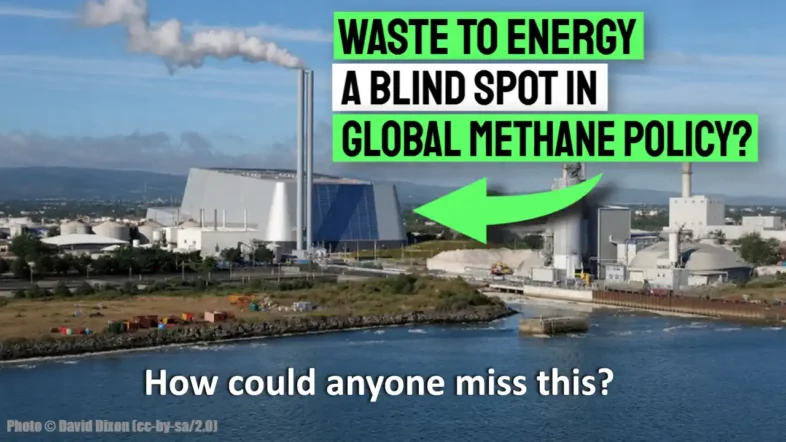
You can see why waste-to-energy (WtE), often just known as “incineration”, has become a blind spot in methane policy. The toughest part of municipal solid waste management is rarely the clean paper, glass, or metals that people picture when they think about recycling; it is the messy residual waste left after sorting.
Maybe most of us would like to forget about our rubbish and WtE incineration, in a huge shed on an industrial estate certainly does that. But half-written reports written by noble bodies can drive the wrong outcomes.
UNEP’s November 2025 Global Methane Status Report puts rapid methane cuts at the centre of climate action and tracks progress against the Global Methane Pledge goal of cutting human-caused methane emissions 30% from 2020 levels by 2030.
What critics dispute is not the urgency, it is the report’s loose use of terms such as energy recovery, which can blur the line between anaerobic digestion, landfill gas use, gasification, and waste-to-energy incineration.
In this page, you will see where that policy gap sits, how anaerobic digestion differs from gasification and thermal treatment, why the waste sector worries about underfunding, and what the WtE+X Knowledge Alliance says should change.
WtE (Municipal Incineration) – Key Takeaways
- The GMSR 2025 treats methane as an urgent climate priority, and that matters because the waste sector accounts for roughly a fifth of human-caused methane emissions worldwide.
- Vague wording around energy recovery can steer finance away from controlled treatment of residual waste, even though poor landfill and dumpsite disposal remains a major methane problem.
- In the United States, the policy contrast is striking: the EPA says municipal solid waste landfills were responsible for about 14.4% of human-related methane emissions in 2022, while a March 2026 EPA rule tightened standards for 57 large municipal waste combustor facilities.
- The WtE+X Knowledge Alliance wants explicit WtE recognition, strict eligibility rules, continuous emissions monitoring, life-cycle assessment, and clear rules for ash residue, fly ash, and bottom ash.
WtE and incineration are a huge and growing proportion of waste management infrastructure in many developed nations. It is scandalous that they are ignored within this report.
What is the UN Global Methane Status Report (GMSR) 2025 emphasising about methane reduction?
The GMSR 2025 makes methane mitigation a front-rank climate priority. UNEP released the report on 17 November 2025, and its core message is direct:
“fast methane cuts can slow near-term warming much faster than waiting for long-term carbon” measures alone.
That focus matters to waste management because waste is not a side issue in the methane story. UNEP’s methane facts page says solid waste and wastewater together produce about 20% of human-driven methane emissions, which means decisions on collection, recycling, composting, digestion, and final disposal can change climate outcomes quickly.
- Prevent methane before it forms: cut avoidable waste and keep organics out of landfills.
- Move up the waste hierarchy: expand recycling, composting, and biological treatment where the waste stream is suitable.
- Improve disposal controls: capture landfill gas and tighten monitoring where landfilling still happens.
The tension starts after those points. The report clearly backs upstream action, but it does not give waste-to-energy plants a stand-alone technical definition for the non-recyclable residual fraction that remains after sorting and biological treatment.
Concerns of the waste management sector
Facility operators, local authorities, and project developers worry that broad methane policy can miss a practical truth: even high-performing systems still produce residual waste. If policy language only rewards prevention, recycling, composting, and anaerobic digestion, cities may be left with landfills, open dumping, or poorly controlled export as the default outlet for what remains.
That concern is not abstract in the U.S. The EPA says landfills are the third-largest source of human-related methane emissions in the country, and its greenhouse gas reporting data show that municipal solid waste landfills make up more than 80% of reported waste-sector emissions. In plain terms, if residual waste keeps going to landfills, methane stays on the table.
What is the stance of the WtE+X Knowledge Alliance?
The WtE+X Knowledge Alliance argues that the UN Global Methane Status Report 2025 under-recognises WtE as a controlled final treatment route for non-recyclable waste. Its position paper, released in April 2026 by partners including CEWEP, ESWET, and WtERT, says the report uses the language of energy recovery without clearly separating thermal systems from biological ones.
That distinction matters because anaerobic digestion is designed for wet, organic feedstocks, while WtE handles the mixed residual fraction left after recycling and source separation. Dr Siegfried Scholz and Prof Huang Qunxing both make the same basic point: methane policy should cover the whole chain, not just the part that is easiest to name.
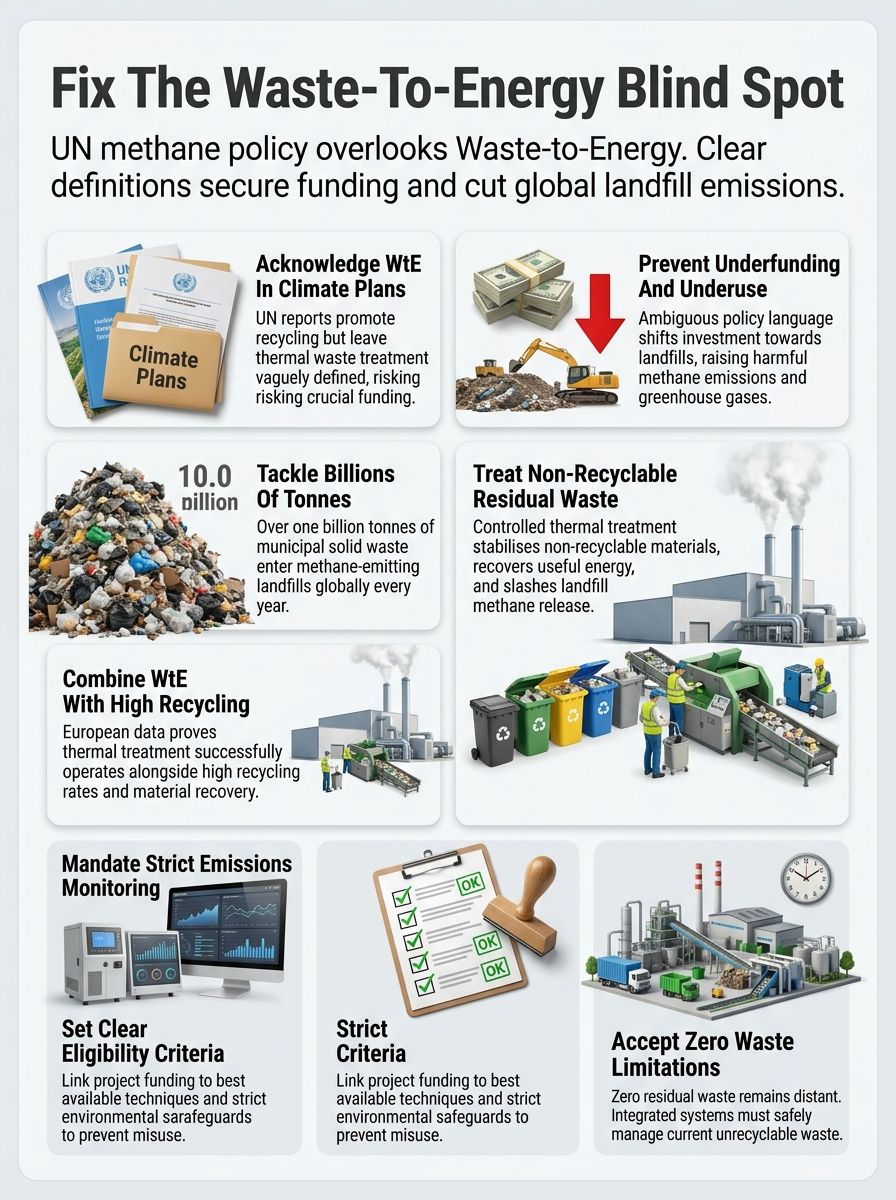
- Recognise Waste-to-Energy as a distinct category in methane policy.
- Define WtE as complementary to recycling and biological treatment, not a replacement for them.
- Link eligibility to best available techniques, emissions monitoring, and life-cycle assessment.
- Set rules for residue handling, including metals recovery from bottom ash and tighter control of fly ash.
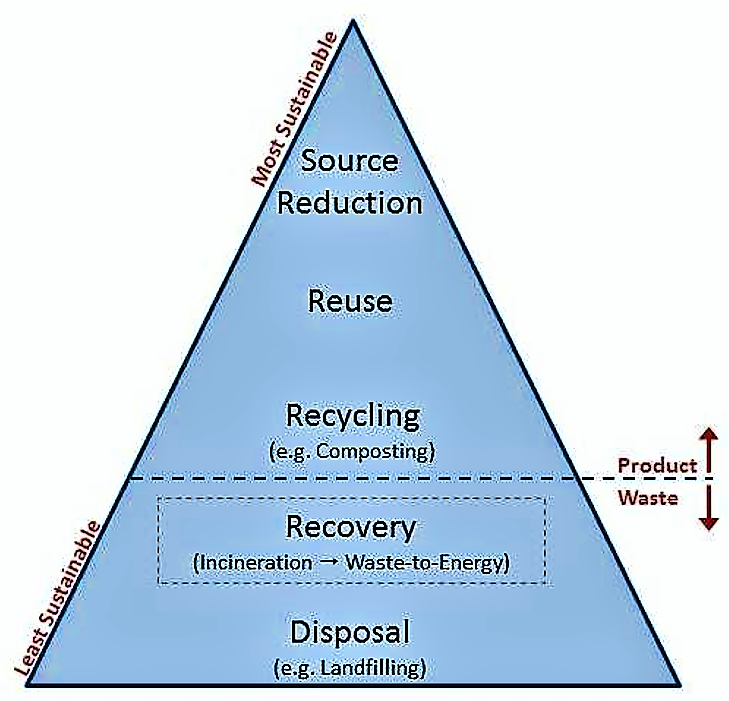
“Incineration (Large-scale) | SSWM …” from sswm.info and used with no modifications.
Why is there a risk of underfunding and underuse of WtE technologies?
Funding systems like clear labels. If a technology is vague in a flagship UN report, it can fall between budget lines for solid waste management, methane mitigation, and renewable energy.
The World Bank has said it provided about US$5.13 billion in official development finance for municipal solid waste management projects between 2003 and 2021. That makes naming important, because public lenders, private investors, and green finance screens often build their rules from the same policy language.
There is also a U.S. signal here. In March 2026, the EPA tightened Clean Air Act standards for 57 large municipal waste combustor facilities covering 152 units, including limits tied to pollutants such as particulate matter, sulphur dioxide, hydrogen chloride, mercury, and dioxins/furans. In other words, controlled waste-to-energy incineration is not an unregulated grey zone, it already sits inside a stricter pollution-control framework than many landfills and dumpsites in lower-capacity systems.
Ambiguity in the Global Methane Status Report
The biggest problem is not that the report (see the cover below) ignores energy from waste completely. It is that the wording is too broad to guide real-world implementation, finance, and emissions accounting.
Why is WtE not clearly defined or recognised in the report?
The report uses energy recovery as a catch-all idea, and that creates confusion across technologies that solve very different problems. If you are a policymaker, investor, or city planner, you need to know what kind of waste each option can actually handle.
| Technology | Best suited for | Main output | Why the distinction matters |
|---|---|---|---|
| Anaerobic digestion | Wet organic materials such as food waste, grease, manure, and wastewater solids | Biogas and digestate, when processed further, become biomethane (RNG) and a fertiliser | The EPA defines AD as microbial breakdown without oxygen, so it works best where organics are clean and separately collected. |
| Gasification | Carbon-based materials prepared for high-temperature conversion | Syngas, mainly hydrogen and carbon monoxide | Gasification needs tighter feedstock control and process design than mixed municipal rubbish dumped straight into a landfill. |
| WtE incineration | Non-recyclable residual municipal solid waste | Heat, steam, electricity generation, and ash residues | It is a final treatment route for residual waste, so it reduces landfill demand and changes methane outcomes even when recycling has already happened. |
Once those routes are lumped together, the practical role of WtE disappears. That makes it harder to write fair rules for environmental impact, energy recovery performance, and climate finance eligibility.
What are the practical impacts of this ambiguity on implementation and funding?
Ambiguity affects decisions far beyond the wording of one report. It can shape which projects qualify for grants, how national methane inventories classify emissions, and whether a city can justify a residual-waste facility instead of another landfill cell.
- Finance risk: investors favour categories with clear technical and legal boundaries.
- Planning risk: cities may overbuild landfill space if residual treatment is treated as optional.
- Inventory risk: emissions can be counted inconsistently if biological and thermal routes are mixed together.
- Procurement risk: local authorities may struggle to compare recycling, digestion, gasification, and incinerator options on equal terms.
That is why the debate is about more than labels. A blurry definition can push real waste back into waste disposal routes that create more methane and fewer opportunities for resource recovery.
How big is the residual waste problem globally?
The scale is much larger than most people realise. UNEP’s Global Waste Management Outlook 2024 projects municipal solid waste generation rising from 2.1 billion tonnes in 2023 to 3.8 billion tonnes by 2050, and the World Bank’s global waste data show that about 37% of waste is still disposed of in some form of landfill, with only 8% going to sanitary landfills that have landfill gas collection systems.
That is the policy backdrop for the WtE debate. If clean organics collection and high recycling rates are still years away in many fast-growing cities, residual waste does not vanish; it shifts into the disposal route that is available.
How does residual waste contribute to greenhouse gas emissions?
Residual waste drives methane when biodegradable material is buried without strong landfill gas capture. Food waste, paper, cardboard, wood, and other biogenic components keep decomposing for years in landfills and dumpsites.
In the United States, EPA reporting for 2023 shows municipal solid waste landfills emitted 82.4 million metric tonnes of CO2 equivalent and accounted for more than 80% of reported waste-sector emissions. That is why residual-waste policy is not a side debate about technology preference, it is a direct debate about greenhouse gases.
Landfills also create a long tail of emissions. Even if a city improves collection tomorrow, waste already buried can keep generating methane for decades.
Why is it urgent to define a role for controlled thermal treatment?
Because the alternative in many places is not perfect recycling. It is more landfilling, more open dumping, and more unmanaged methane.
- Volume reduction: EIA says a typical U.S. WtE plant can reduce 2,000 pounds of waste to roughly 300 to 600 pounds of ash and cut volume by about 87%.
- Residuals management: bottom ash can often be processed to recover metals, while fly ash usually needs tighter handling because contaminants are more concentrated.
- Urban land pressure: dense urban areas have limited space for new landfill cells and long haul routes raise costs.
- Energy system value: thermal plants can supply steady heat and electricity generation from waste that would otherwise decay.
That does not make WtE/ incineration the first option in the waste hierarchy. It makes it a serious option for the fraction that remains after prevention, recycling, and biological treatment have done their work.
The role of WtE in the EU waste management system
The EU gives a useful example because it regulates WtE as part of a wider system, not as a shortcut around recycling. The revised Industrial Emissions Directive, known as IED 2.0, entered into force on 4 August 2024, and the EU already relies on the Waste Framework Directive and Best Available Techniques to set permit conditions for controlled thermal treatment.
That matters for readers in the U.S. because it shows a practical model: you can push a circular economy, maintain high recycling, and still regulate a waste-to-energy plant as a tightly monitored final treatment asset.
How do strict regulations and best available techniques (BAT) affect WtE?
Strict rules change the argument from ideology to performance. The European Commission’s 2019 waste incineration BAT conclusions introduced tougher monitoring, including continuous measurement for key air pollutants, continuous mercury monitoring in many cases, and long-term sampling for dioxins and furans.
Plants, therefore, have to prove compliance, not just claim it. Operators use continuous emissions monitoring systems, advanced pollution control, and documented operating procedures to keep emissions within permit limits.
- Permits are based on defined BAT conclusions, achieving the best that the “best available technologies” can achieve, not vague promises.
- Monitoring covers air emissions, operating conditions, and residue handling.
- Performance rules support public trust because regulators can inspect data rather than rely on marketing language.
Is there evidence that WtE coexists with high recycling rates effectively?
Yes. Eurostat’s latest 2023 figures show that the EU recycled 48.2% of municipal waste, incinerated 25.2%, and landfilled 22.5%.
| 2023 EU municipal waste picture | What the numbers suggest |
|---|---|
| 511 kg generated per person | The system still has a large waste flow to manage, even in a mature policy market. |
| 248 kg recycled per person | High recycling can scale alongside other treatment routes. |
| 129 kg incinerated per person | Energy recovery still plays a meaningful role for residual waste. |
| 115 kg landfilled per person | Lower landfill reliance is possible, but it depends on having alternatives in place. |
The practical lesson is simple. High recycling rates do not remove the need for residual-waste treatment (e.g. WtE incineration); they change what that treatment should handle.
Why do we need a comprehensive framework for methane emissions?
Policymakers need one framework that links Measurement, Reporting, and Verification (MRV), landfill gas capture, recycling, composting, anaerobic digestion, and controlled thermal treatment. Without that link, countries end up with fragmented inventories, uneven permits, and climate plans that reward what they can easily count rather than what actually cuts methane.
For the public, this is the practical point: methane policy works best when it follows the waste chain from bin collection to final treatment, instead of treating each facility type as a separate world.
How can methane emissions be addressed across the waste management chain?
- Cut organics at source: expand prevention, food rescue, separate collection, composting, and digestion for suitable feedstocks.
- Tighten landfill controls: require gas collection, better maintenance, and stronger monitoring for active and closed sites.
- Define residual treatment clearly: recognise WtE for non-recyclable waste that cannot be managed well through biological routes.
- Measure outcomes: tie finance and permits to verified emissions, energy performance, and residue management.
State rules in the U.S. show where this is going. Washington adopted a landfill methane rule in May 2024 that requires affected landfill owners and operators to install gas collection and control equipment, energy recovery devices, or treatment and processing systems to reduce emissions.
Are emission reduction reports scientifically complete?
They are useful, but they are rarely complete on their own. A methane report can show where emissions sit, while Life Cycle Assessment asks what happens across the whole system, from collection and transport to treatment, energy use, and residue handling.
That is why measurement, reporting and verification matter so much. In October 2024, the EPA opened a public docket on municipal solid waste landfills to gather input on fenceline monitoring, emerging technologies, and ways to harmonise landfill emissions rules, which is a sign that even mature systems still need better data.
- Inventories tell you where methane is reported.
- LCA helps you compare disposal and treatment pathways on a full-system basis.
- Facility monitoring tells you whether individual sites are actually performing as permitted.
Proposals from the WtE+X Knowledge Alliance for WtE Incineration
The Alliance is not asking policymakers to treat WtE as the first answer to every waste problem. It is asking them to define where WtE belongs, what standards it must meet, and how it should sit beside recycling, digestion, and landfill controls.
Why should WtE be explicitly recognised?
Explicit recognition would turn WtE from a vague afterthought into a regulated decision category. That helps governments write clearer climate finance rules, set better procurement standards, and compare WtE with composting, digestion, and landfill upgrades on a like-for-like basis.
It also protects against bad substitution. If policymakers ignore WtE in methane strategy, the fallback is often not zero waste, it is more waste disposal in landfills or dumpsites.
For that reason, the Alliance wants WtE named directly in frameworks that already cite tools such as the EU Waste Framework Directive, life-cycle assessment, and national greenhouse gas inventories.
How should the complementary role of WtE be defined?
It should be defined by what it does, and by what it does not do.
| Route | Primary job | What it should not replace |
|---|---|---|
| Recycling | Recover materials that can return to production | It should not be weakened by sending recyclable feedstocks to incinerators. |
| Anaerobic digestion | Treat clean organic waste and produce biogas | It should not be forced to handle mixed residual waste it was not designed for. |
| WtE (Incineration) | Treat non-recyclable residual municipal solid waste with energy recovery | It should not become a shortcut for untreated recyclables or regulated hazardous waste streams. |
That framing is useful because it gives each tool a realistic role. It also makes abuse easier to spot.
What eligibility criteria should be established for WtE?
Clear eligibility rules help separate a modern residual-waste facility from a poor-quality incinerator. The Alliance is right to push for criteria that are easy to inspect and hard to game.
- BAT alignment: require high-efficiency combustion or equivalent thermal control, advanced flue-gas cleaning, and permit conditions based on recognised technical standards.
- Strict waste acceptance: WtE should focus on post-recycling residuals, not become a routine route for untreated medical, chemical, or other hazardous wastes that need separate controls.
- Robust MRV: require continuous emission monitoring, third-party verification, and public reporting of key operating and emissions data.
- Residue plan: require documented handling for bottom ash, fly ash, metals recovery, and final disposal of contaminated residues.
- Energy recovery threshold: prioritise plants that deliver useful electricity, steam, district heat, or combined heat and power rather than simple burn-and-dump models.
- Circular economy safeguards: tie permits and public finance to high recycling targets, separate collection schemes, and proof that WtE is treating residual waste rather than displacing recovery.
Why is policy coherence important for waste and methane management?
Policy coherence means the same government does not fund landfill diversion with one hand and then write methane rules that ignore the residual treatment route with the other. It links methane accounting, landfill gas capture, digestion, thermal treatment, and financing into one workable system.
What is the case for a global reference document?
A global reference document would give countries a common playbook. That is especially helpful for places building waste infrastructure quickly and trying to avoid locking in decades of methane from unmanaged disposal.
- Define the roles of recycling, biological treatment, landfill gas capture, and WtE.
- Set minimum monitoring and reporting standards that fit national methane inventories.
- Use life-cycle assessment for technology comparisons, not slogans.
- Give development banks and private lenders a shared basis for project screening.
That kind of document would not force every country into the same system. It would simply stop the waste chain from being described differently in every funding memo and every climate plan.
How realistic is the goal of zero residual waste?
It is an important direction, but it is not a near-term reality. Global waste volumes are still rising, landfill use remains widespread, and even the U.S. is still adding methane controls to existing disposal infrastructure.
| Reality check | What it means |
|---|---|
| Waste could grow to 3.8 billion tonnes by 2050 | Residual waste planning cannot be postponed. |
| Only 8% of global waste goes to sanitary landfills with gas collection | Many regions still lack even basic methane control at final disposal sites. |
| The EPA identified 313 U.S. anaerobic digestion facilities processing food waste by 2024, likely an undercount | Biological treatment is growing, but it still does not remove the need for other residual-waste solutions. |
The realistic goal is not instant zero residual waste. It is to keep shrinking the residual fraction while making sure the remainder does not become a methane problem. WtE incineration can meet this requirement.
How have the GMSR authors responded to these issues?
The public record is still thin. The report page and launch materials explain the GMSR 2025 as a progress update on methane mitigation, but they do not, as of April 2026, include a separate technical addendum that clearly defines waste-to-energy as its own category in the waste chapter. WtE is effectively incineration.
So the clearest response so far is indirect. The report strongly supports prevention, recycling, composting, anaerobic digestion, and landfill gas action, while the WtE+X Knowledge Alliance is pressing for a follow-up clarification on residual waste, emissions criteria, and implementation rules.
That leaves a practical opening. Policymakers, lenders, and national authorities can still tighten their own methane frameworks now, instead of waiting for a perfect global document.
WtE Incineration – Conclusion
The debate is not really about whether methane matters. It is about whether climate policy treats the full waste chain honestly, including the residual fraction that recycling and digestion do not eliminate.
Waste-to-energy should not displace better waste prevention or recycling. It should be defined clearly, regulated tightly, and used where it cuts landfill methane faster than the real-world alternative.
FAQs
1. What is Waste To Energy and why does it matter for global methane policy?
Waste To Energy, or WtE, turns waste into usable power and heat. It matters because the waste sector can drive or cut methane emissions, so policy must link WtE and methane goals.
2. Can WtE cut methane emissions from the waste sector?
Yes, diverting waste to WtE can lower methane from waste sites by reducing decay in dumps. Operators must also control waste gas and limit on-site losses to keep net gains.
3. Is the waste sector a blind spot in global methane policy?
Many plans focus on fossil fuels, while the waste sector gets less attention, so it often is a blind spot.
4. What actions should policy makers take on WtE and methane?
Set clear rules that require gas capture, monitoring and reporting for WtE plants. Fund pilot projects and data-driven reviews to prove real emission cuts. Use standards that reward energy recovery when it truly reduces emissions.
Attribution: Featured image, Photo © Copyright David Dixon and licensed for reuse under a cc-by-sa/2.0 Creative Commons Licence.
Innovative Waste Management Ideas: Transforming The Future Of Waste Disposal
Everyone wants to live in a clean world, but rubbish makes it hard. We know that smart ways to handle waste can change the future. Innovative waste management leverages advanced technology and circular economy models to minimize landfill usage and reclaim valuable resources. Key trends include AI-powered sorting facilities, smart IoT bins for optimizing collection […]
Old Electronics Recycling: How To Responsibly Dispose Of Unwanted Devices
You probably have at least 25 unused electronic devices sitting in drawers or cupboards right now. Most households do because most neglect their old electronics recycling. And most people have no clear plan for what to do with their old electronic devices when they go wrong.. Here’s the key issue: those devices aren’t just clutter. […]
Revolutionizing Waste Recovery: Latest Separation And Sorting Innovations
Waste recovery is changing fast, thanks to new separation and sorting technology. This tech helps us sort trash better, so we can recycle more things. For example, Stadler has built a big plant in Spain for VAERSA that makes recycling easier and smarter. Keson is finding new ways to deal with old tyres, helping both […]
Top 10 UK Solid Waste Management Companies 2025
The UK waste management sector stands as a vital industry worth billions of pounds. The top UK Solid Waste Management Companies are the leading waste management firms in Britain. These companies handle millions of tonnes of rubbish each year. The industry has transformed significantly over the past two decades through strategic mergers and environmental innovations. […]